Samsung Music Studio 5 Review: Where Designer Aesthetics Meet Wireless Audio Ambition
Samsung's first dedicated wireless speaker pairs Erwan Bouroullec's striking design with Q-Symphony ecosystem integration and Ai-driven room calibration, delivering sound that punches above its weight—but connectivity gaps and middling stereo imaging keep it from dethroning Sonos.
Samsung has spent the better part of a decade dominating the television market and building a soundbar empire that now spans from budget bars under $200 to premium Atmos systems pushing four figures. Dedicated two-channel speakers and a whole-home music ecosystem, however, have never really been part of the conversation—until now. With the Music Studio 5 (HW-LS50H), Samsung is making its first serious move into wireless whole-home audio, and the $299 speaker brings enough design ambition and sonic capability to make the established players take notice.
The Music Studio 5 is the smaller of Samsung's two new wireless speakers, sitting below the $499 Music Studio 7 (LS70H) in a lineup that is clearly intended to challenge Sonos, Bluesound, and Apple's HomePod for space on your shelf. Unlike those products, Samsung has partnered with renowned French designer Erwan Bouroullec to create something that does not look like a speaker—or at least, does not look like a conventional one. The result is a product that blends into your living space in a way that most wireless speakers simply do not, while delivering sound that is significantly more capable than its compact dimensions suggest.
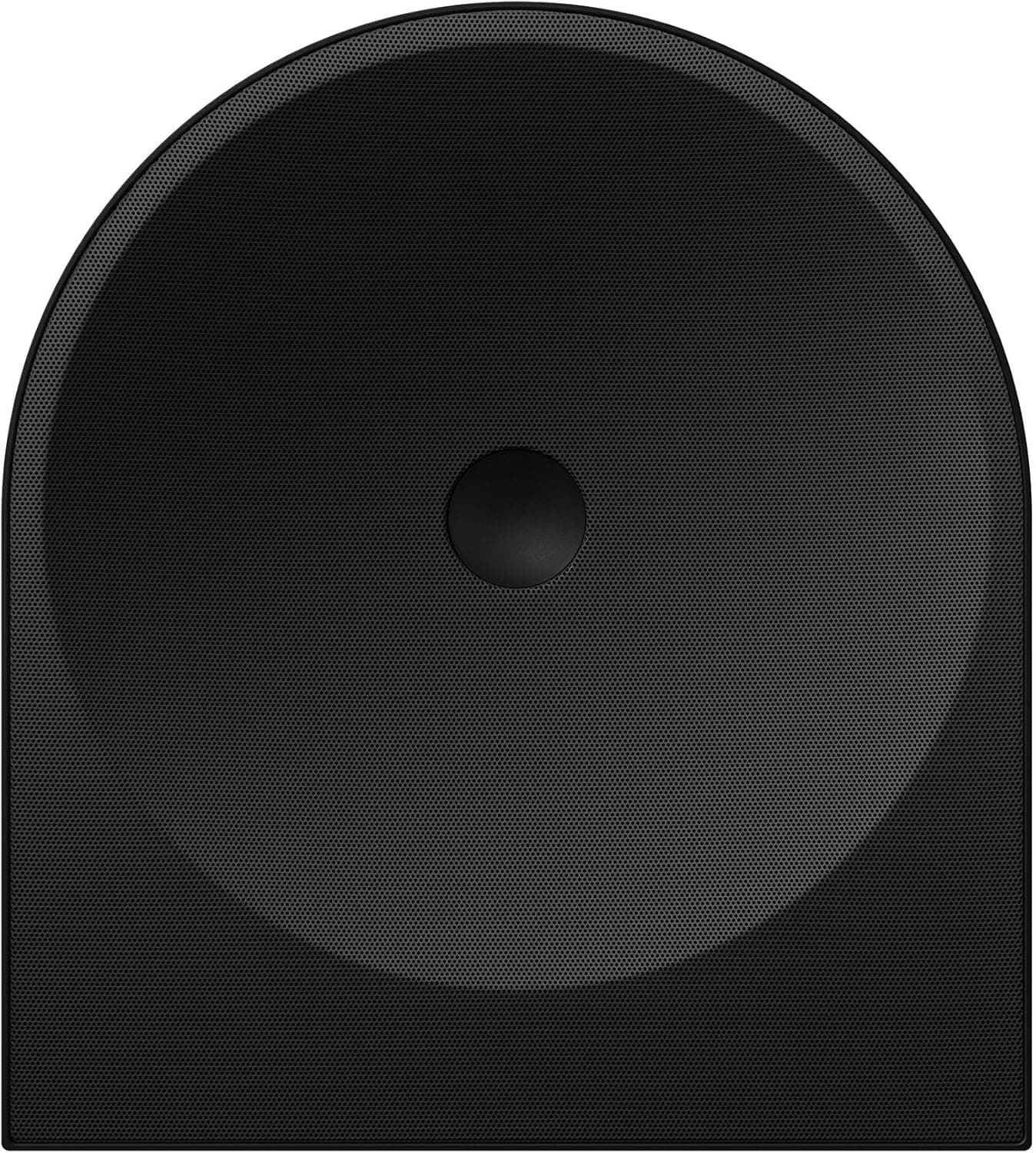
Standing 9.88 inches tall, 11.18 inches wide, and 5.39 inches deep, the Music Studio 5 is not what anyone would call a small speaker, but it occupies far less visual real estate than its dimensions might imply. The arched-tombstone shape—a rounded top that flows into a rectangular base—gives it an architectural quality that borrows more from modern furniture design than from traditional audio equipment. The front face is an unbroken expanse of acoustically transparent mesh that covers the entire speaker surface, pierced only by a small circular indentation in the upper section that serves as an acoustic lens for the tweeter. Available in Black or White, the Music Studio 5 is designed to sit unobtrusively on a shelf, bookcase, or side table, looking more like an artful home accessory than a piece of electronics.
The all-plastic construction keeps the weight down to 5.29 pounds, which makes it easy to move between rooms when you want to reconfigure your setup. There are no exposed speaker cones—the mesh covers everything—and no physical buttons anywhere on the front or sides. Touch controls live on the top surface: a single strip that handles play, pause, volume, and track skipping with a series of taps and swipes. The controls are responsive, with a satisfying tactile pulse when you make contact, and a dim LED strip along the top edge provides visual feedback without being distracting in a dark room. The lack of visible hardware gives the speaker a clean, monolithic appearance that the Bouroullec design language demands.
Under the mesh, the Music Studio 5 houses a 2-channel speaker system delivering 70 watts of total power. The driver configuration includes a woofer and a tweeter arrangement that Samsung has paired with its Audio Lab Pattern Control technology, which manages sound distribution across both channels to reduce overlap and congestion. The result is a speaker that throws a surprisingly wide sound stage for its size, with better left-right separation than you might expect from a single enclosure. Samsung's Waveguide Technology also plays a role here, directing and dispersing sound evenly throughout the room so that the listening sweet spot is wider than what most single-speaker systems can achieve.
Connectivity is where the Music Studio 5 shows its Samsung roots—and its Samsung ambitions. Wi-Fi and Bluetooth 6.0 are both supported, giving you the option of high-quality wireless streaming from any device. Apple AirPlay 2 and Google Chromecast are built in, as is Spotify Connect for direct streaming from the Spotify app. Roon Ready support is coming via a future firmware update, which will make the Music Studio 5 an attractive option for the serious music management crowd. There is also an optical input for connecting to a TV or other source, though notably absent are analog inputs, USB playback, and a phono stage. For most users in 2026, the wireless options will be more than sufficient, but vinyl enthusiasts and those with legacy analog sources will need to look elsewhere or invest in an external DAC and preamp combination.
The Samsung Sound app (also accessible through the SmartThings app) serves as the control center for the Music Studio 5. The interface is clean and functional, offering seven-band equalization when using the speaker in single mode, along with access to SpaceFit Sound Pro, Active Voice Amplifier Pro, and various sound presets. You can also manage multi-room groupings, adjust individual speaker volumes, and configure Q-Symphony settings from within the app. The app is not as polished or intuitive as the Sonos app—it has a learning curve and some of the grouping options are buried in submenus—but it is functional and stable once you understand the layout.
SpaceFit Sound Pro is Samsung's room calibration system, which uses the speaker's built-in microphones to measure your room's acoustic properties and adjust the speaker's output accordingly. The process takes about 15 seconds and produces a noticeable improvement in balance and clarity, particularly in rooms with lots of hard surfaces that cause reflections. The calibration auto-recalibrates daily or whenever the speaker is moved to a different location, which is a thoughtful touch that means you do not have to revisit the setup every time you rearrange your furniture. In testing, the calibrated sound was consistently more balanced and less boomy than the uncalibrated default, with clearer midrange and better-defined treble.
Active Voice Amplifier Pro (AVA Pro) is Samsung's dialogue enhancement technology, originally developed for soundbars but now applied to the Music Studio 5. It analyzes ambient noise in real-time and boosts vocal frequencies to ensure that dialogue remains clear even when background noise increases. In practice, it is most useful when watching TV content through the speaker, where it does a credible job of lifting voices above sound effects and music. For music listening, the effect is less noticeable and can sometimes introduce a slight thinness to vocal tracks that have already been mixed with prominent vocal presence.
AI Dynamic Bass Control is another feature carried over from Samsung's soundbar lineup. It adjusts bass output in real-time based on the content being played, boosting low frequencies during music and action scenes while pulling them back during dialogue-heavy passages. The effect is subtle but noticeable, and it helps the Music Studio 5 deliver more low-end punch than its physical dimensions would suggest. The speaker also supports hi-res audio decoding up to 24-bit/96kHz, which means it can handle lossless files from Tidal, Qobuz, and Amazon Music HD without downscaling. The caveat is that hi-res streaming requires a Wi-Fi connection—Bluetooth 6.0 simply does not have the bandwidth for 24-bit files.
Q-Symphony is the feature that ties the Music Studio 5 into Samsung's broader ecosystem. When paired with a compatible Samsung TV (2022 models BU8000 and above, 2023 CU7000 and above, 2024 DU7000 and above, and 2025 U8000F/U8000H and above, plus The Frame and Frame Pro from 2022 through 2026), the speaker works in concert with the TV's built-in speakers to create a wider, more immersive sound stage. The Music Studio 5 can serve as a stand-alone TV speaker, work alongside a Samsung soundbar for additional height and width channels, or pair with other Music Studio speakers for whole-home audio. The system supports up to 10 speakers in a whole-home group and up to 5 speakers in a home theater configuration.
When running in stereo pair mode with two Music Studio 5 units, the sound quality improves dramatically. Individual 2-channel speakers can sound a bit limited in terms of stereo separation—understandable given that both channels are coming from a single enclosure—but in a stereo pair, the Music Studio 5 units deliver substantial sub-bass, an open-sounding midrange, and a treble that is present without being excessive. Maximum volume is impressively loud for the size, easily filling a medium-to-large room without noticeable distortion. The sub-bass reaches lower than expected, with real weight and rumble on electronic and hip-hop tracks that demonstrates the dynamic bass control is doing genuine work. This is where the Music Studio 5 punches above its weight class—a single unit sounds good, but a stereo pair sounds genuinely impressive for the combined price of roughly $600.
That said, the stereo imaging and instrument layering are not class-leading. Multiple instruments occupying the same frequency range can blur together, and the sound stage, while wide, is not particularly deep. If you are accustomed to the spatial precision of dedicated bookshelf speakers or higher-end wireless options from Sonos and Bluesound, you will notice the Music Studio 5's limitations in this area. The sound is best described as forward rather than enveloping—pleasant and impactful, but not the sort of three-dimensional imaging that invites you to close your eyes and get lost in the music. For casual listening and background music, it excels. For critical listening sessions where you want to dissect every instrument in a dense mix, you will find the resolution wanting.
Q-Symphony mode with a Samsung TV is a mixed bag. Adding the Music Studio 5 to a compatible TV does expand the stereo image and add some much-needed mid and low-end weight to the TV's built-in speakers. However, the improvement is incremental rather than transformational. If you are coming from a TV's standalone speakers, you will hear an obvious difference. If you are comparing it to a proper soundbar or a dedicated stereo pair, the Q-Symphony setup sounds like what it is: a TV's speakers with a small assist from a wireless speaker. It is useful but not revelatory, and users expecting a dramatic home theater upgrade from a single Music Studio 5 will need to adjust their expectations.
Where the Music Studio 5 truly shines is as a standalone music speaker. Streaming via Wi-Fi or Bluetooth delivers clean, full-range sound that punches well above its weight class. The bass extension goes lower than you might expect from a speaker this size—the dynamic bass control is doing real work here—and the midrange has enough openness and clarity to make vocal-centric music sound natural and engaging. Pop, electronic, and hip-hop tracks benefit from the bass boost and forward presentation. Acoustic music and jazz are enjoyable if not reference-grade. Classical music holds up reasonably well but lacks the spatial depth and instrument separation that more expensive dedicated speakers provide.
Dolby Atmos support is listed in the specifications, but it is important to understand what this means in practice. The Music Studio 5 supports virtualized Dolby Atmos—it uses digital processing to create a sense of spatial height and width from a single enclosure. It does not deliver the discrete overhead and surround channels that a proper Atmos system with height drivers would provide. The effect is subtle: a slightly more expansive sound stage with some perceived height when playing Atmos-mixed content from supported streaming services. It is a nice addition for watching Atmos-encoded TV shows and movies, but it is not the sort of immersive experience that will make you feel like you are in a Dolby Cinema.
The Music Studio 5 also supports Eclipsa Audio, an open immersive audio format developed jointly by Samsung and Google. Eclipsa Audio content is available on YouTube, making it the only immersive format on the platform. This is a noteworthy inclusion for users who consume a lot of YouTube content and want spatialized audio without needing a full Atmos setup, though the content library is still relatively limited compared to Dolby's ecosystem.
The Music Studio 5 does have some limitations that are worth acknowledging. There is no DTS support of any kind—no DTS:X, DTS 5.1, DTS-HD, or DTS Express. For users with large libraries of DTS-encoded content, this is a significant omission. There is no analog input, no USB playback, and no phono preamp for turntable users. There is also no remote control included, though you can control volume and playback through the Samsung Sound app, your phone's volume controls when streaming via Bluetooth, or the touch panel on top of the speaker. The lack of an HDMI eARC port, which is available on the larger Music Studio 7, means you cannot connect the Music Studio 5 directly to your TV with a single cable. Instead, you connect via optical or Wi-Fi, both of which work fine but are less convenient than the single-cable solution that eARC provides.
Comparing the Music Studio 5 to its direct competitors clarifies its position. The Sonos Era 100 at $279 is the most obvious comparison. It offers similar sound quality with better stereo separation from its dual-driver configuration, deeper app integration with a more mature ecosystem, and AirPlay 2 support. However, the Sonos lacks the Music Studio 5's Dolby Atmos support, Q-Symphony integration with Samsung TVs, and the distinctive Bouroullec design that makes the Samsung a more attractive living room object. The Apple HomePod at $299 delivers superior smart home integration and better Siri voice control, but it sounds more closed-in and less expansive than the Music Studio 5. The Bluesound Pulse Flex 2i at approximately $299 offers superior codec support including MQA and native integration with the BluOS ecosystem, but its utilitarian design makes it look like what it is—a piece of audio equipment—rather than a design object you are happy to display.
The Music Studio 5's design is arguably its most compelling attribute. In a market saturated with cylindrical and boxy speakers that look like they were designed by engineers for engineers, the Bouroullec collaboration gives the Music Studio 5 an aesthetic identity that is rare in consumer audio. The arched shape, the unbroken mesh face, and the absence of visible controls create an object that invites contemplation rather than just listening. It is the kind of speaker that guests will ask about, and that you will not feel the need to hide when company comes over.
The build quality, while entirely plastic, feels solid and well-constructed. The mesh is taut and evenly applied, with no warping or visible seams. The weight distribution is balanced enough that the speaker does not vibrate or walk across a smooth surface at high volume, which is a problem that plagues some lighter wireless speakers. The touch panel on top is responsive and easy to find by feel, even in a dark room. Power consumption is modest—the Music Studio 5 draws approximately 30 watts at typical listening levels and peaks around 70 watts at maximum volume. There is no battery option since the speaker is AC-powered only, which limits its portability but is consistent with its positioning as a fixed home audio product rather than a portable speaker.
The setup process is straightforward. Plug it in, download the Samsung Sound or SmartThings app, and follow the pairing instructions. Wi-Fi setup was quick in testing, though some users have reported connectivity issues with certain router configurations—particularly those using DFS channels on 5GHz networks. Samsung's app walks you through the process, and once connected, the speaker appears in your SmartThings dashboard alongside any other Samsung devices you own. Firmware updates are delivered over the air and generally take less than five minutes to install.
Is the Samsung Music Studio 5 worth $299? The answer depends almost entirely on how you plan to use it. As a standalone music speaker, it delivers more than enough sound quality and volume for most rooms, with a design that makes it easy to place in any living space without it looking like an afterthought. As part of a Samsung ecosystem—paired with a compatible TV, expanded with additional Music Studio speakers for whole-home audio, or configured as a stereo pair—it becomes considerably more compelling, offering a level of integration that competing products cannot match if you already own Samsung TVs or soundbars.
For audio purists with extensive physical media collections or those who demand reference-grade stereo imaging and instrument layering, the Music Studio 5 will feel like a lifestyle product first and an audio performer second. It is not designed to replace a pair of KEF LS3/5As or a KEF LSX II system—it is designed to fill a very specific gap in the market between soundbars and traditional Hi-Fi, and to do it while looking better than anything else in that space.
Samsung's decision to partner with Erwan Bouroullec is telling. The company knows that competing on sound quality alone against established players like Sonos and Bluesound is an uphill battle. By investing in design that elevates the Music Studio 5 from a black box to a piece of modern home decor, Samsung is appealing to the customer who wants their technology to disappear into their home rather than dominate it. For that customer, the Music Studio 5 offers a combination of design, sound, and ecosystem integration that no other single product at this price point can match.
Where the Music Studio 5 falls short is in audio fidelity for critical listening and connectivity flexibility for diverse source setups. The absence of analog inputs, USB playback, DTS decoding, and HDMI eARC are real limitations for users with diverse source components. The virtualized Dolby Atmos, while a nice differentiator on paper, does not deliver a sufficiently immersive experience to be a primary selling point. And the Wi-Fi connectivity, while generally reliable, has enough reported issues with certain router configurations that it is worth checking your network setup before committing to the ecosystem.
But for the user who streams most of their music, watches TV through a Samsung display, and wants a speaker that looks as good as it sounds, the Music Studio 5 is a strong first effort from Samsung. It is not the best-sounding speaker at $299, nor is it the most feature-complete. But it might be the best-looking, and in a product category where the speaker is going to live in your living room for years, that matters more than spec sheets might suggest. Samsung has clearly signaled that it intends to be a serious player in wireless home audio, and the Music Studio 5 is a credible opening move that promises even better things to come.Sony LinkBuds Open Review · JBL Flip 7 Review · Bose SoundLink Max Review
Pros
- Striking Erwan Bouroullec design that integrates beautifully into living spaces
- SpaceFit Sound Pro room calibration delivers noticeable improvement in balance and clarity
- Q-Symphony integration with Samsung TVs adds genuine versatility to the ecosystem
- Strong bass response for the size thanks to AI Dynamic Bass Control
- Wi-Fi and Bluetooth 6.0 plus AirPlay 2 and Chromecast for broad streaming support
Cons
- No analog input, USB playback, or phono stage limits connectivity flexibility
- No DTS support of any kind is a significant playback gap
- Virtualized Dolby Atmos is subtle rather than immersive
- No HDMI eARC port—only available on the larger Music Studio 7
Final Verdict
Samsung's first dedicated wireless speaker pairs Erwan Bouroullec's striking design with Q-Symphony ecosystem integration and Ai-driven room calibration, delivering sound that punches above its weight—but connectivity gaps and middling stereo imaging keep it from dethroning Sonos.