Sony LinkBuds Open Review: The Best-Sounding Open-Ear Earbuds Get a Worthy Upgrade
The Sony LinkBuds Open refine the open-ring earbud concept with improved fit via Air Fitting Supporters, surprisingly strong audio from an 11mm ring driver, and the best companion app in the open-ear category—but middling battery life and a $228 price tag demand careful consideration.
Sony set out to reimagine how we listen to music in environments where total isolation is not just undesirable but actively dangerous. The original LinkBuds, released in 2022, introduced a ring-shaped driver with a literal hole through the center—an idea so unusual that even seasoned audio reviewers needed a moment to process what they were looking at. Three years later, the Sony LinkBuds Open arrive as the refined, more mature evolution of that concept, keeping the open-ring philosophy while addressing nearly every complaint lodged at the first generation. The result is a pair of earbuds that delivers surprisingly strong audio for an open design, a feature set that beats most competitors in this category, and a fit that finally feels secure enough for daily use. But at $228 on Amazon, they also demand a close look at whether the premium is justified.
The open-ear earbud category has exploded over the past two years. Where Sony once stood nearly alone with its donut-hole driver concept, it now competes against clip-on designs from Bose, Nothing, Shokz, and Huawei. The fundamental pitch is the same across all of them: listen to your music, podcasts, and calls while remaining fully aware of the world around you. No sealed ear canal, no pressure buildup, no need to pop an earbud out when someone starts talking to you. The LinkBuds Open approach this differently from the clip-on crowd, and that distinction—both in how they sound and how they feel—is what defines the experience.
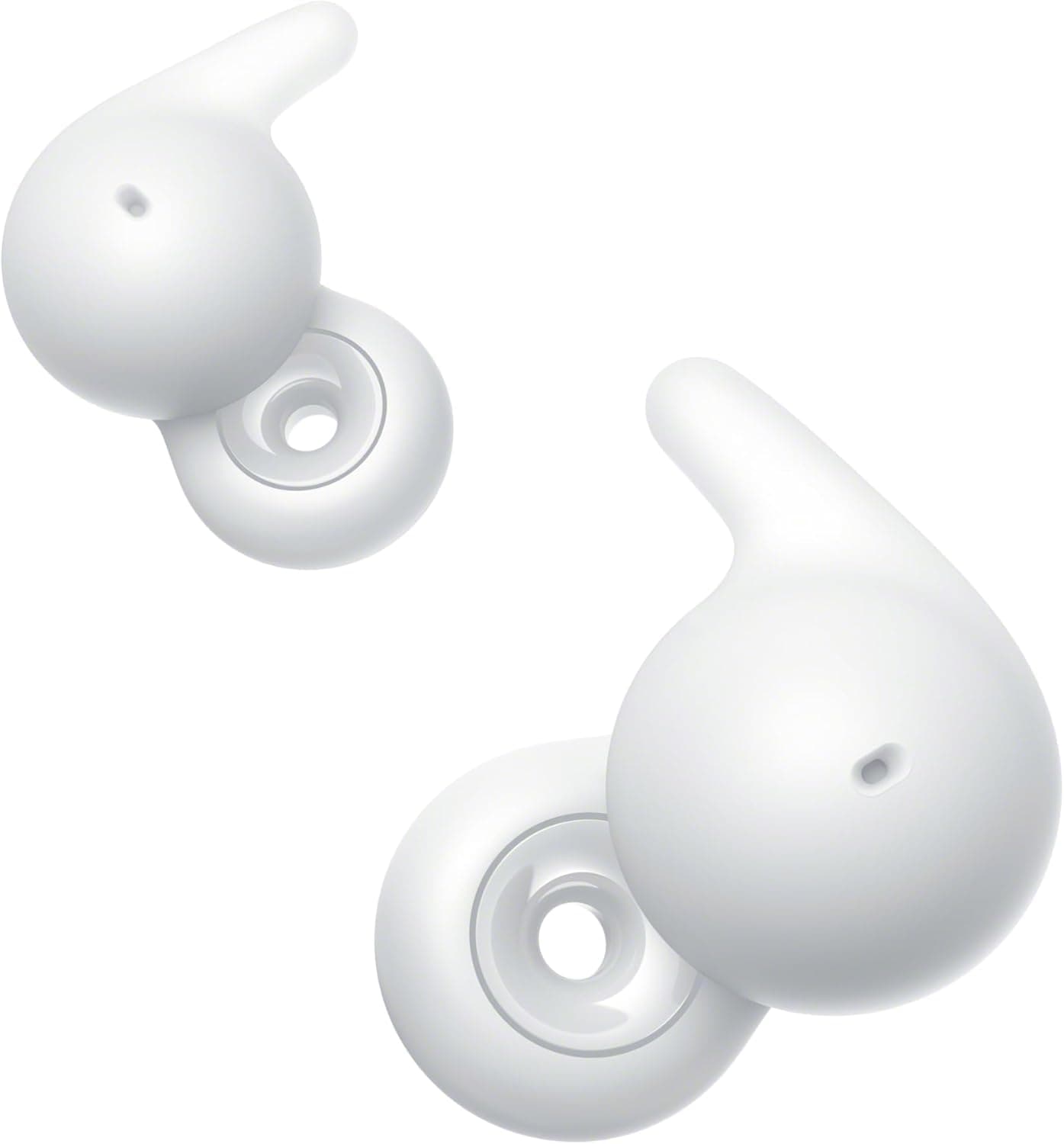
Let's start with the design, because it is impossible to discuss these earbuds without addressing their appearance. Each LinkBuds Open bud consists of two connected circular elements: an orb-shaped housing that contains the battery, processor, and microphones, and a ring-shaped driver that sits over your ear canal. A flexible silicone wing extends from the top of the orb and tucks into the fold of your outer ear, holding everything in place. In your hand, they look a bit like infinity symbols—two loops joined together, one solid and one hollow. In your ear, they are surprisingly discreet. The driver ring nestles just inside the entrance of the ear canal, and the battery orb sits in the concha, mostly hidden from view. They are far less conspicuous than the industrial look of the Bose Ultra Open Earbuds or the dangling pods of clip-on designs from other manufacturers.
That said, the LinkBuds Open are not what anyone would call elegant. The twin-circle design is distinctive, but distinctive is not the same as attractive. The orb portion has a smooth, polished plastic finish, while the ring driver has a matte texture. The contrast works better in the White and Violet colorways than in Black, where the two surfaces tend to blend together under indoor lighting. Sony offers three colors: Black, White, and a Violet shade created in collaboration with Olivia Rodrigo that includes a custom EQ tuning preset. Interchangeable wings come in the box, and Sony sells additional wing-tip color packs (Ash Blue, Ash Green, Ash Pink, Ash Violet, Pure Black) for $9.99, which allows you to personalize both the fit and the appearance of each earbud.
The fit is where the LinkBuds Open take a significant step forward from their predecessor. The original LinkBuds relied entirely on a foam-tipped ring wedged into your ear, and getting a stable seal felt like solving a puzzle every time you put them in. The new Air Fitting Supporters—Sony's clinical name for the silicone wings—solve this problem elegantly. They add a physical anchor point that holds the bud in place with far more confidence than the original design ever achieved. During extended testing, the LinkBuds Open stayed secure through head shakes, light jogging, and the kind of casual movement that defines an average day. They never fell out, and they never needed adjusting after the initial placement. The one caveat is that initial placement still takes a moment. You need to position the driver ring over your ear canal and let the wing settle into the upper fold of your ear. This takes about fifteen seconds once you develop the muscle memory, but it is noticeably longer than simply pushing in a pair of traditional earbuds and walking away.
Comfort over extended sessions is solid but not exceptional. The open design means zero ear canal pressure, which is the primary advantage over sealed alternatives. You can wear these for six or seven hours without the fatigue that sets in with in-ear monitors or pro-style earbuds. However, the wing does apply mild pressure to the upper fold of the ear, and after about four hours, some users will notice a slight tenderness at that contact point. The buds weigh just 5.1 grams each, which is light enough that their presence fades into the background during most activities. The charging case is a compact 1.16 by 1.81 by 1.81 inches, with a glossy, marble-like finish that looks premium and picks up fewer fingerprints than you might expect. It fits easily in a pants pocket, and the hinge mechanism has a satisfying snap when closing. There is no wireless charging, which is a notable omission at this price tier—you are limited to USB-C for topping up the case.
Battery life is respectable but unremarkable. The earbuds themselves deliver 8 hours on a single charge, and the case provides an additional 14 hours, for a total of 22 hours. That trails the Nothing Ear (Open), which offers 8 hours per charge and 22 additional from its case for a 30-hour total. The LinkBuds Open do offer quick charging—three minutes in the case gives you roughly 60 minutes of playback—which partially offsets the middling total capacity. You are unlikely to run out during a normal day, but heavy users who forget to charge for a couple of days will feel the constraint. A full charge of the earbuds from empty takes approximately 90 minutes, and a full case recharge takes about two hours via USB-C. The lack of wireless charging means you cannot simply drop the case on a Qi pad overnight, which is a convenience that competing products at similar price points offer as standard.
Connectivity is handled by Bluetooth 5.3 with multipoint support, meaning you can stay connected to your phone and laptop simultaneously without manual switching. Codec support includes SBC, AAC, and LC3, but notably absent is Sony's own LDAC hi-res codec. This is a frustrating omission, particularly given that Sony's own WF-1000XM6 flagship earbuds support LDAC at a similar price point. The LC3 codec does offer improved efficiency over SBC and AAC, which helps with battery life and call quality on compatible devices, but for audiophiles who have invested in hi-res streaming services like Tidal or Qobuz, the lack of LDAC means the LinkBuds Open cannot deliver the full resolution of your source material.
The Sony Sound Connect app is where these earbuds truly separate themselves from the competition. It is hands-down the best companion app in the open-ear category, and it is not particularly close. The interface is clean, modern, and logically organized, with sections for EQ, Bluetooth settings, voice features, and system preferences clearly tabbed and easy to navigate. The equalizer section offers multiple presets (Bright, Excited, Mellow, Relaxed, Vocal, Bass Boost, and Speech) alongside two custom five-band profiles with sliders covering 400 Hz through 16 kHz. The standout feature is "Find Your Equalizer," a gamified tool that plays short audio clips and asks you to choose between them, progressively building a custom EQ profile based on your stated preferences. It is intuitive, surprisingly accurate, and far more useful than just sliding frequency bars around blindly.
Beyond EQ, the app offers adaptive volume that automatically adjusts playback levels based on ambient noise levels—louder on busy streets, quieter in your living room—and a wearing condition check that plays a test tone through each bud to verify that the driver ring is properly positioned over your ear canal. The "Find Your Buds" feature can trigger a sound from each earbud independently, and it shows the last known location on a map within the app. Head gesture controls let you nod to accept incoming calls or shake your head to reject them—a feature that works reliably most of the time but occasionally misinterprets a head turn as a shake, especially if you are walking briskly or looking around frequently. Touch controls on the buds themselves offer play, pause, track skipping, and volume adjustment via repeated taps on the left or right earbud.
The feature list continues with 360 Reality Audio support for compatible streaming services—a spatial audio format that Sony has been pushing for several years—Spotify Tap integration that lets you resume your last listening session with a long press, and DSEE (Digital Sound Enhancement Engine) upscaling that attempts to restore harmonic frequencies lost during audio compression. The DSEE processing makes a subtle but audible difference on low-bitrate streams, adding a touch of air and openness that compressed files often lack. It will not transform a 128 kbps stream into something resembling lossless, but it does narrow the gap slightly, and the effect is more noticeable on acoustic music and vocal-centric tracks than on bass-heavy electronic genres.
The IPX4 water resistance rating means the LinkBuds Open can handle sweat and light rain without issue, making them suitable for outdoor exercise and everyday wear. They are not designed for swimming or submersion—no open-ear earbud currently on the market is—but for running, cycling, and gym use, the rating provides adequate protection against the moisture encounters that define an active lifestyle.
Now let's talk about the most important thing: sound quality. Open-ear earbuds face an inherent acoustic challenge that sealed designs simply do not. By leaving the ear canal unsealed, they sacrifice bass impact, noise isolation, and dynamic range in exchange for environmental awareness. The question is not whether the LinkBuds Open sound as good as sealed earbuds at this price—they do not, and they cannot within the laws of acoustics—but rather how close they get and whether the gap is acceptable given the situational awareness trade-off you gain in return.
The answer is: closer than anything else in this category. The 11mm ring driver positions itself directly over the ear canal opening, and this proximity allows it to deliver bass that is genuinely surprising for an unsealed design. On tracks with prominent low-end content—Kendrick Lamar's "Loyalty" served as a revealing test track—the kick drum lands with real weight and the bass synth has presence and texture that open-ear competitors like the Nothing Ear (Open) and Shokz OpenFit simply cannot match. The sub-bass region below about 50 Hz drops off as physics demands, but the mid-bass through lower midrange is present and engaging in a way that makes the LinkBuds Open feel like a serious audio product rather than a novelty.
The midrange is the LinkBuds Open's strongest frequency band. Vocals come through clearly and with a natural tonality that avoids the chesty or nasal coloration that afflicts many open designs. Bill Callahan's baritone on "Drover" sounds round and present, with enough chest resonance to feel intimate without losing intelligibility. Acoustic guitar figures have reasonable body, though the attack on plucked strings is softened compared to what you hear from sealed earbuds or over-ear headphones. This softening of transient detail is a trade-off inherent to the form factor, not a tuning mistake. With the John Adams orchestral piece "The Gospel According to the Other Mary," instruments separate clearly across the sound stage, and brass tones have reasonable though not exceptional bite.
Treble response is generally smooth, with good extension and enough sparkle to keep cymbals and sibilant consonants audible. Out of the box, the tuning leans slightly bright, which can make some recordings sound harsh or fatiguing during extended listening sessions, particularly with already-bright sources like certain pop and electronic masters. This brightness is easily corrected with the app's EQ, and after spending time with the "Find Your Equalizer" tool and manual adjustments, I found a profile that tamed the upper treble without sacrificing detail retrieval. Once properly tuned, the overall presentation is balanced enough for casual and semi-serious listening across most genres, from electronic and hip-hop to classical and jazz.
Sound leakage is the unavoidable companion of the open design. At moderate volumes, someone sitting immediately next to you on a bus will hear a faint version of your music emanating from the ring drivers. At higher volumes, the leakage becomes noticeable and potentially annoying to anyone within a few feet. This is not unique to the LinkBuds Open—it is a characteristic shared by every open-ear product—but it is worth emphasizing because it limits where you can use these without being inconsiderate to the people around you. Quiet offices, outdoor walks, and home listening are all fine environments. Packed subway cars and shared coworking spaces at high volume are not ideal scenarios for these earbuds.
Microphone quality for calls is competent but not exceptional. The LinkBuds Open use Sony's AI voice pickup technology, which combines beamforming microphones with machine learning to isolate your voice from ambient noise. In quiet environments, calls sound clear and present, with your voice coming through naturally. In noisier settings like a café or a windy street, the AI processing does a reasonable job of suppressing background sound while keeping your voice recognizable, though it occasionally renders speech with a slightly processed, digital quality that some callers find unnatural. The head gesture nod-to-answer feature is genuinely useful during calls, allowing you to accept incoming conversations without reaching for your phone—a small convenience that adds up over the course of a full workday.
Comparing the LinkBuds Open directly to their primary competitors clarifies their market position. The Bose Ultra Open Earbuds cost $299 and offer a clip-on design that many find more comfortable, along with a more polished aesthetic, but they sound noticeably thinner and less engaging than the LinkBuds Open, with weaker bass and less detail retrieval across the frequency range. The Nothing Ear (Open) at $149 provides better battery life (30 hours total) and a more conventional clip-on approach, but its sound delivery is more subdued and less vivid than what Sony achieves here, and its bass lacks the weight and texture of the LinkBuds Open. The Huawei FreeArc at approximately $130 delivers surprising value with an IP57 water and dust rating and solid sound for the price, but it lacks the app depth, EQ customization, and feature breadth that make the Sony experience so comprehensive. The Apple AirPods 4 with ANC at $179 occupy a different position entirely—they add active noise cancellation alongside their partially open design—but iPhone users will naturally gravitate toward them for the ecosystem integration and seamless switching between Apple devices.
The competitive landscape puts the LinkBuds Open in an interesting position. They are the best-sounding open-ear earbuds you can buy right now, paired with the best companion app and the most comprehensive feature set in the category. They are also among the most expensive options in this form factor, and their battery life and lack of wireless charging are real drawbacks at this price point. Whether the premium is justified depends entirely on how much you value audio quality and app customization relative to battery convenience and overall cost.
For runners, walkers, and anyone who spends significant time outdoors with earbuds in, the situational awareness the LinkBuds Open provide is not a luxury—it is a safety feature. Being able to hear approaching vehicles, cycling bells, and conversation-starting colleagues without removing an earbud changes the listening experience in a fundamental way. The secure fit means you can jog without worrying about a bud flying off mid-stride. The IPX4 water resistance handles sweat and light rain without complaint. And the sound quality, while not at the level of sealed alternatives, is good enough that you will actually enjoy listening rather than merely tolerating the compromise.
For office workers, the value proposition is similarly compelling. The open design lets you participate in ambient conversation, hear your name called across the room, and maintain awareness of the office soundscape while simultaneously enjoying your preferred audio content. The multipoint Bluetooth connection means you can switch between your computer and phone without manual pairing, and the head gesture controls let you manage calls without the social awkwardness of tapping your ear in the middle of a meeting.
Where the LinkBuds Open fall short is in environments where you genuinely want isolation from your surroundings. Airplanes, noisy commuter trains, and loud cafes are all scenarios where an unsealed earbud is fighting against overwhelming ambient noise. In these situations, a sealed earbud with active noise cancellation—even a mid-range model at half the price—will serve you significantly better. The LinkBuds Open are not trying to solve that problem, and they should not be evaluated on how poorly they handle use cases they were explicitly designed to avoid.
Sony has refined a conceptually bold product into something genuinely usable. The original LinkBuds were an interesting experiment hampered by fit issues, mediocre sound, and limited features. The LinkBuds Open address the fit with the Air Fitting Supporters, improve the sound quality with a redesigned 11mm driver, and wrap everything in the most comprehensive app experience available in the open-ear category. They are not perfect—the battery life is middling, the design language will not appeal to everyone, and the sound leakage at high volumes is a real limitation—but they are the best open-ear earbuds available right now for listeners who prioritize audio quality and customization alongside situational awareness.
If your daily listening happens primarily in environments where awareness matters—outdoor exercise, office work, casual neighborhood walks, cooking while listening to podcasts—the Sony LinkBuds Open deliver an experience that no sealed earbud can replicate. You hear the world and your music simultaneously, and both come through with enough quality that neither feels like a compromise. At $228, they ask for a meaningful investment, but for the right user, that investment pays daily dividends in safety, comfort, and the simple pleasure of never needing to remove an earbud just to hear what is happening around you.Samsung Music Studio 5 Review · Bowers & Wilkins PX8 S2 Review · DJI Mic Mini Review
Pros
- Best-in-class audio quality for open-ear earbuds
- Secure fit with Air Fitting Supporters that stay in place during activity
- Feature-rich Sony Sound Connect app with gamified EQ and adaptive volume
- Compact and discreet design compared to clip-on competitors
- Multipoint Bluetooth and head gesture controls for convenience
Cons
- Middling battery life at 22 hours total trails competitors
- No wireless charging for the case at this price point
- Sound leakage at higher volumes limits use in quiet shared spaces
- No LDAC hi-res codec support despite Sony's own flagship offering it
Final Verdict
The Sony LinkBuds Open refine the open-ring earbud concept with improved fit via Air Fitting Supporters, surprisingly strong audio from an 11mm ring driver, and the best companion app in the open-ear category—but middling battery life and a $228 price tag demand careful consideration.