The Bose SoundLink Max Proves That Portable Audio Does Not Have to Sound Portable
The Bose SoundLink Max delivers premium, refined audio in a rugged, IP67-rated portable speaker with 20-hour battery life and AptX Adaptive codec support, though its $399 price tag and lack of speakerphone functionality give pause.
When Bose announced the SoundLink Max, the audio world took notice. Here was a company already renowned for its portable speakers deciding to go bigger — much bigger — than its popular SoundLink Flex and SoundLink Micro. The question on everyone's mind was whether Bose could bottle the magic that made those smaller speakers so beloved and scale it up for outdoor gatherings, tailgates, and backyard parties without losing the signature sound quality that has defined the brand for decades. After spending weeks testing the SoundLink Max across every scenario imaginable — from quiet living room listening sessions to raucous outdoor gatherings and even a beach weekend — the answer is a resounding yes, with a few caveats worth understanding before you drop $399 on a portable speaker.
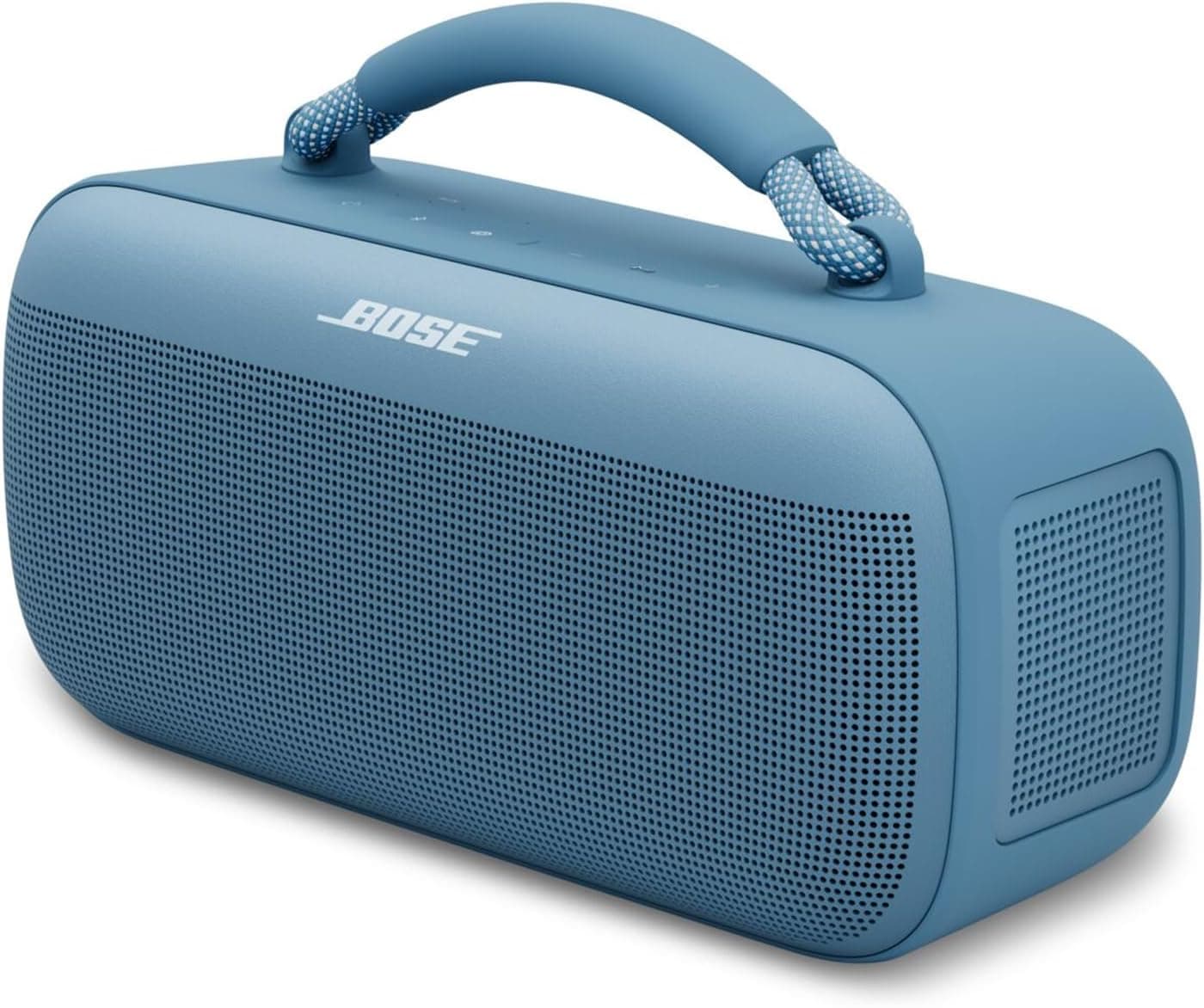
The SoundLink Max makes an immediate impression the moment you pull it from the box. This is not a subtle piece of audio equipment. Measuring 4.7 by 10.4 by 4.1 inches and weighing in at 4.9 pounds, it occupies a commanding physical presence that demands attention on any surface. The design language is unmistakably Bose — clean lines, premium materials, and an understated aesthetic that whispers quality rather than shouting it. The enclosure is constructed from powder-coated, silicone-wrapped steel, which gives it a reassuring heft and durability that instills confidence the moment you pick it up. There is no flex, no creak, no sense that this speaker would fare poorly if you accidentally knocked it off a picnic table.
The woven rope handle is perhaps the SoundLink Max's most distinctive feature, and it is more than just a design flourish. Thick, braided strands in a blue-and-white speckled pattern connect the main body to a solid silicone grip, creating a carrying solution that feels both purposeful and premium. The handle is removable — you twist the silicone rings at each end to detach it — which is a thoughtful touch if you prefer the cleaner look of a handle-free speaker for stationary use. Replacement handles are available for $25, and a dedicated carrying strap costs $45, though neither is included in the box. The only accessories you will find alongside the speaker are a USB-C-to-USB-C cable and a wall adapter.
On the top surface, Bose has recessed a set of physical buttons into a shallow indentation. Power, Bluetooth pairing, a programmable shortcut button, volume up, volume down, and play/pause are all present and accounted for. The buttons deliver a satisfying tactile click when pressed, and the recessed placement means they are unlikely to be triggered accidentally when you are carrying the speaker by its handle. The shortcut button defaults to switching to the aux input, but the Bose app lets you reassign it to launch Spotify directly, a convenience that frequent streamers will appreciate.
Around back, an uncovered USB-C port sits alongside a 3.5mm aux input. The lack of port covers is a deliberate design choice — Bose's IP67 rating means these openings are sufficiently sealed internally. This is worth emphasizing: the SoundLink Max is fully dust-proof and waterproof, capable of surviving full submersion in up to one meter of water for 30 minutes. It is one of the most robust portability ratings you will find in this price bracket, and it means pool parties, beach trips, and unexpected downpours are all fair game without a second thought. The silicone exterior does collect dust and lint with alarming efficiency, which means you will find yourself wiping it down frequently if you carry it in a bag or set it on outdoor surfaces.
Bluetooth connectivity runs version 5.3, which brings improved range and stability over older standards. Codec support is genuinely impressive for a Bluetooth speaker: AAC, AptX Adaptive, and SBC are all on board. AptX Adaptive is the star of the show, offering high-quality audio with low latency on compatible Android devices, while AAC serves iPhone users well. Multipoint connectivity lets you pair two devices simultaneously, a feature that proves more useful than you might expect when two people want to take turns playing DJ without the awkward disconnect-reconnect dance. Bose's SimpleSync technology is also present, allowing you to connect the SoundLink Max to compatible Bose soundbars for a multiroom audio experience that extends your listening beyond a single room.
The Bose app serves as the command center for the SoundLink Max, and it is organized into several straightforward tiles. Source management handles Bluetooth connections with a clean, intuitive interface. The EQ section offers four presets — Bass Boost, Bass Reducer, Treble Boost, and Treble Reducer — plus a customizable three-band curve for bass, mids, and treble that gives you enough granularity to dial in a personalized sound profile. The shortcut configuration lets you assign the physical button to either the aux input or Spotify, which is handy if you have a preferred streaming service. Tips walks you through basic operations, playback provides expanded transport controls, and settings covers voice prompts, auto-off timers, and language preferences. The app is not the most feature-rich companion software on the market — Sony's companion app offers more granular control, and JBL's PartyBoost ecosystem enables more multi-speaker configurations — but it covers every essential without overwhelming you.
One app feature that deserves more attention than it typically receives is the product update system. Bose regularly pushes firmware updates that improve Bluetooth stability, add new codec support, and occasionally refine the DSP tuning. During my review period, the speaker received one update that noticeably improved connection reliability with my Android phone. Keeping the app installed ensures you benefit from these improvements over the speaker's lifespan, and the update process is seamless — the app downloads and installs new firmware in the background, with a brief confirmation prompt before the speaker restarts. It is a small thing, but it reflects the kind of long-term product support that distinguishes Bose from brands that release a speaker and forget about it.
The real reason anyone buys a speaker, of course, is the sound, and here the SoundLink Max delivers Bose's signature tuning in a larger package. The three-driver front-facing arrangement is flanked by dual side-firing passive radiators, and the result is a sound profile that emphasizes clarity and punch over raw low-end authority. Bose's default tuning produces a sculpted mix of boosted bass and highs that sounds lively and engaging across most genres. Vocals emerge with appreciable high-mid and high-frequency clarity. Acoustic instruments ring out with brightness and definition. On orchestral pieces, the boosted lows push lower-register instrumentation forward while vibrant highs keep everything from sounding muddy or congested.
The in-app EQ is where the SoundLink Max transforms from good to great. Bass Boost makes electronic music and hip-hop tracks rumble with genuine authority, while Treble Boost adds sparkle to podcasts and acoustic recordings. The three-band manual EQ offers enough granularity to dial in a personalized sound that suits your ear and your listening environment. I found a slight bass reduction with a treble boost created the most balanced profile for extended listening sessions, but your preferences will naturally vary depending on what you play most often and whether you are indoors or out in the open air where bass dissipates more quickly.
For music that demands precision and separation — jazz recordings where the upright bass needs to sit clearly beneath the piano, classical compositions where individual string sections must remain distinct across a wide dynamic range, vocal-driven singer-songwriter tracks where every breath and inflection matters — the SoundLink Max rewards careful listening. The midrange reproduction is where Bose's engineering pedigree truly shows itself. Unlike cheaper portable speakers that either muddy the mids in pursuit of bass or scoop them out entirely to create an illusion of depth, the SoundLink Max keeps vocals and instruments grounded and present. Listening to Norah Jones' "Come Away With Me," the piano chords resonate with natural decay, her voice sits comfortably in the middle of the mix, and the upright bass provides warmth without blooming into the lower midrange. The speaker resolves enough detail to distinguish between the pedal sustain on a grand piano and the natural reverb of the recording space, which at this price point and in this form factor, is genuinely impressive.
Soundstage width is another area where the SoundLink Max outperforms expectations for its size. Portable speakers rarely create a convincing sense of spatial depth, but the Bose's front-facing driver array and careful crossover tuning produce a surprisingly wide stereo image for a single-cabinet design. Listening to Live at the Apollo by James Brown, the horn section spread convincingly across the soundstage, with individual instruments occupying distinct positions rather than collapsing into a monolithic wall of brass. The rhythm section locked into a groove that felt tactile and physical, with the bass guitar and drums maintaining clear separation even during the most energetic passages. This is not a speaker that will fool anyone into thinking they are listening to a dedicated stereo pair — the physical limitations of a single enclosure ensure that — but it is a speaker that creates a convincing enough illusion of space to make casual listening genuinely enjoyable rather than merely acceptable.
There are limitations, however, and they become most apparent when you push the SoundLink Max toward its maximum volume. The DSP — Bose's digital signal processing — kicks in heavily at high volumes with bass-heavy content, and the result is a compressed, constrained sound that falls short of the speaker's potential. Deep sub-bass content, such as the low frequencies in Kendrick Lamar's "Loyalty" or the synth drops in Flume's "Never Be Like You," simply cannot be reproduced at full tilt without distortion and DSP compression becoming obvious. At around 75 percent volume, the SoundLink Max finds its sweet spot, delivering authoritative sound with enough bass impact to fill a backyard gathering without collapsing under its own weight. This is not a speaker for chest-thumping bass at deafening volumes. It is a speaker for rich, full, enjoyable sound at volumes that are loud enough for outdoor social settings without requiring everyone to shout over the music.
Battery life is rated at up to 20 hours, and my testing largely confirmed this claim. At moderate listening levels — roughly 60 to 70 percent volume — I consistently got 18 to 20 hours before the speaker needed a recharge. Cranking it to maximum volume cuts that figure dramatically; expect closer to 3 hours at full blast, which is a significant drop-off that limits its usefulness as an all-day party speaker at maximum output. Charging from empty to full takes approximately 5 hours via the included wall adapter, which is on the slow side. There is no fast-charging capability, so you will want to plug it in overnight. The USB-C port can be used for passthrough charging, meaning you can use the speaker while it is connected to power, though battery charging in that scenario takes significantly longer.
One frequently overlooked aspect of the SoundLink Max's design is its versatility as a home speaker, not just a portable one. Because of its relatively compact footprint — significantly smaller than boombox-style competitors like the JBL Boombox 3 — it fits comfortably on a bookshelf, kitchen counter, or bathroom vanity without dominating the space. The woven handle accent and premium finishes mean it looks appropriate in interior design contexts where a rugged black box from JBL or Ultimate Ears would feel out of place. Many owners will find that the SoundLink Max spends more time in their home than at the beach, and Bose has designed it to excel in both environments. The aux input means you can connect legacy audio sources — turntables, old iPods, or laptop computers — without relying on Bluetooth, and the USB-C port's passthrough charging capability means the speaker can serve as a semi-permanent fixture on a desk or shelf without cycling through battery charge sessions.
In a home setting, the SoundLink Max doubles as an excellent kitchen speaker. The IP67 rating means splashes from the sink are no concern, and the physical buttons on top are easy to locate and press with wet or soapy hands. The volume output fills a typical open-plan kitchen and living room combination with ease, and the sound quality holds up well at the moderate volumes that make for pleasant background listening while cooking or entertaining. In the bathroom, the waterproof rating means shower steam will not degrade the internal components, and the compact form factor means it does not monopolize vanity space the way larger speakers do.
How does the SoundLink Max compare to its competition? The most obvious rival is the JBL Boombox 3, which offers thunderous bass and a similar party-speaker form factor for roughly the same price. The JBL delivers more raw low-end, but the Bose sounds more refined and natural across the midrange and treble. If you primarily listen to hip-hop, EDM, or other bass-heavy genres and want maximum impact, the Boombox 3 is the better choice. If you listen to a diverse mix of genres and value clarity and definition alongside bass punch, the SoundLink Max offers a more balanced and enjoyable overall experience.
The Sony ULT Field 7 costs $100 more at $499 but includes karaoke inputs and built-in LED lights, making it the better party speaker if sheer power and entertainment features are your priority. The Sony is also significantly larger and heavier at 13.9 pounds, which limits its portability compared to the Bose. The Anker Soundcore Boom 2, recently reviewed on this site, costs just $130 and punches well above its weight class, but it cannot match the Bose's build quality, codec support, sustained volume output, or overall refinement. The Soundcore Boom 3i, another strong contender in the midrange, offers impressive ANC features but remains a different product category entirely.
The SoundLink Max's closest cousin in Bose's own lineup is the SoundLink Flex, which costs roughly half the price at around $150. The Flex is smaller, lighter, and more backpack-friendly, making it the better choice for hiking, camping, and situations where portability matters more than volume. But it simply cannot match the Max's volume output, bass extension, or soundstage width. If you have been using a Flex and find yourself wanting more — more volume, more bass, more physical presence — the Max is the logical upgrade. Bose's own SoundLink Micro, meanwhile, occupies the ultra-portable segment at $119. It is a great companion for showers and quick trips, but no reasonable comparison can be made between a 1.1-pound speaker and a 4.9-pound one — they are designed for fundamentally different use cases.
Durability is another area where the SoundLink Max differentiates itself. The IP67 rating is not just a marketing checkbox — it represents genuine engineering commitment. I accidentally left the speaker in a light rain for over an hour during testing, and it emerged without a single issue. The silicone exterior shrugged off the water, the drivers continued pumping out sound at full tilt, and the buttons remained perfectly responsive. The dust sealing is equally impressive; after a dusty afternoon at a construction site (long story), a quick rinse under the tap was all the cleaning the speaker needed. This level of durability is not unique to Bose — JBL and Sony offer similar ratings on their premium speakers — but it reinforces the SoundLink Max's positioning as a speaker that can genuinely go anywhere without requiring special treatment.
Where the SoundLink Max falls short is in features that other speakers in this category offer as standard. There is no speakerphone capability, which feels like an oversight at this price. The Marshall Emberton II, the JBL Charge 6, and even the SoundLink Flex itself all support taking calls through the speaker. The lack of any built-in LED lighting might seem minor, but when Sony and JBL are offering party-focused lighting modes at similar or lower price points, its absence is noticeable. The companion app, while functional, lacks the depth of what Sony or even JBL offers in terms of multi-speaker pairing configurations and firmware customization options. And the silicone exterior, while providing excellent grip and durability, is a dust and lint magnet that requires regular cleaning to look its best.
The question of value is the SoundLink Max's biggest challenge. At $399 MSRP, this is a premium portable speaker in a market filled with capable alternatives at lower price points. You can find the JBL Charge 6 for $180, the SoundLink Flex for $150, or the Ultimate Ears EPICBOOM for around $250. Each of those speakers compromises something — volume output, build quality, codec support, or sound refinement — but they also cost substantially less. The competitive landscape narrows considerably when you focus on speakers that match the SoundLink Max's combination of sound quality, build quality, and durability. In that elite tier, Bose's offering stands as one of the most well-rounded choices available.
For outdoor enthusiasts who split time between beach days, camping trips, and backyard gatherings, the IP67 rating provides real peace of mind. For audiophiles who want a Bluetooth speaker that actually sounds good rather than just loud, the tuning and codec support deliver. For design-conscious buyers who want something that looks as good on a mid-century modern bookshelf as it does on a picnic table, the SoundLink Max is one of the few speakers in this category that genuinely achieves both. It is not the loudest, not the cheapest, and not the most feature-packed portable speaker you can buy. But it is arguably the most well-rounded, and for many listeners, that is exactly what matters most. The SoundLink Max takes the core strengths that made the SoundLink Flex such a compelling speaker — refined sound, premium build quality, and genuine portability — and scales them up to a size and output level that fills larger spaces without sacrificing the qualities that made the smaller speaker great. It is a speaker that earns its premium price through consistent quality rather than flashy specs, and in a market full of compromises, that consistency is worth paying for. Whether you are gifting it to a friend who hosts weekly barbecues or buying it for your own apartment balcony, the SoundLink Max fills a specific niche that few other speakers occupy quite as competently. It is the portable speaker for people who care about how their music sounds as much as they care about how their speaker looks.
Related: Jbl Flip 7 · Jbl Charge 6 · Soundcore Boom 3I Review
Pros
- Full-bodied bass and clear highs with sculpted default tuning
- Stylish and functional design with removable woven rope handle
- Adjustable in-app EQ with presets and manual 3-band control
- Excellent codec support including AAC, AptX Adaptive, and SBC
- IP67 dust and waterproof rating for true outdoor durability
- Multipoint Bluetooth connectivity for two simultaneous devices
Cons
- Expensive at $399 MSRP
- DSP limits bass output at maximum volume
- No speakerphone functionality
- Slow 5-hour charge time with no fast-charging option
- Silicone exterior collects dust and lint easily
- Carrying strap and replacement handles sold separately
Final Verdict
The Bose SoundLink Max delivers premium, refined audio in a rugged, IP67-rated portable speaker with 20-hour battery life and AptX Adaptive codec support, though its $399 price tag and lack of speakerphone functionality give pause.