Apple Watch Series 10 Review: The Thinnest, Most Capable Apple Watch Yet
[Limited Stock - Alert] The best Apple Watch for most people. Thinner design, larger display, and sleep apnea detection at a reasonable price.
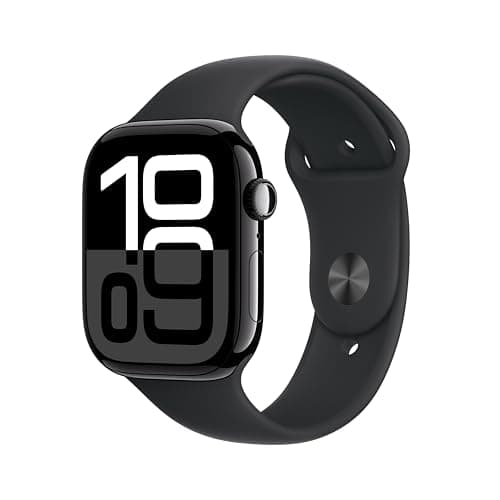
The Apple Watch Series 10 represents Apple's tenth-generation flagship smartwatch, introducing the slimmest profile in the watch's history alongside the largest display ever fitted to an Apple Watch. Announced in September 2024 and released later that fall, the Series 10 brought meaningful hardware improvements over its predecessors while maintaining the essential watchOS experience that has defined Apple's wearable platform since its inception in 2015. The watch arrived with a suggested retail price of $399 for the aluminum GPS model, positioning it as a direct successor to the Apple Watch Series 9 while offering notable refinements in design, display technology, and health monitoring capabilities. This review examines the Series 10 across all critical dimensions—industrial design, display performance, health and fitness features, processing capabilities, software ecosystem, and overall value proposition—to determine whether this tenth-anniversary hardware delivers meaningful upgrades worth considering for both existing Apple Watch users and those new to the platform.
Industrial Design and Build Quality
Apple's engineering team achieved a remarkable physical transformation with the Series 10, reducing the case thickness to just 9.7mm—a 10% reduction compared to the Series 9's 10.7mm profile. This slimming down required complete internal redesign, including a new metal chassis with an integrated antenna and repositioned internal components to maintain structural integrity while dramatically improving wrist comfort during extended wear. The reduction in thickness becomes immediately apparent when wearing the watch daily, particularly during sleep tracking sessions where a bulkier device can become uncomfortable against the wrist bones and tendons. Many users who found the Series 9 or earlier models too thick for comfortable overnight wear report that the Series 10's profile resolves this issue almost entirely, making all-day and all-night continuous wear genuinely practical for the first time in the Apple Watch lineup.
The case construction options mirror previous generations, with aluminum remaining the entry-level material at $399 while titanium variants start at $699 for the GPS + Cellular configuration. The aluminum models use Ion-X strengthened glass over the display, similar to previous aluminum Apple Watches, while titanium models feature sapphire crystal for superior scratch resistance. Both materials receive the same internal specifications and processing power, so the upgrade to titanium represents purely aesthetic and durability considerations rather than functional differences. The aluminum finish options for the Series 10 include Midnight (a dark blue-black), Silver, and a new Rose Gold that Apple introduced specifically for this generation, while titanium models are available in Natural titanium, Black, and a polished Bronze option exclusive to the highest-end configurations.
Weight reduction accompanies the thinner profile, with the 46mm aluminum GPS model weighing just 29.2 grams—significantly lighter than the 38.8 grams of the comparable Series 9 45mm aluminum variant. This weight savings compounds with the reduced thickness to create what many long-time Apple Watch users describe as a fundamentally different wearing experience. The watch no longer feels like a tech gadget strapped to the wrist but rather integrates more naturally as a timepiece and health monitoring device. The 42mm aluminum model weighs an even more remarkable 26.7 grams, making it suitable for users with smaller wrists or those who prefer minimal presence during physical activities. Despite the weight reduction, Apple's quality standards remain evident in the case construction—no creaking, flexing, or compromises in button feedback quality compared to previous generations.
The digital crown and side button maintain their established positions and functionality, with the crown providing precise haptic feedback for scrolling through menus and the side button offering quick access to Control Center and Apple Pay through single and double-press gestures respectively. The speaker and microphone grilles maintain their placement on the left side of the case, and the back sensor array continues its prominence as the defining visual element of the Apple Watch's underside. Water resistance remains at 50 meters depth rating, allowing for swimming tracking in pools and open water without concern for damage, though the watch should not be used for recreational scuba diving or high-pressure water activities that exceed the specified rating.
Display Technology and Visual Experience
The Apple Watch Series 10 introduces the most significant display upgrade in the watch's history, featuring a new LTPO3 OLED panel that delivers improvements across brightness, contrast, and energy efficiency. The 46mm model features a 1.99-inch display with 416 by 502 pixels, while the 42mm version offers 1.77 inches of viewing area at 374 by 446 pixels—both representing meaningful increases over the Series 9's 45mm and 41mm options. The pixel density remains at approximately 326 pixels per inch, maintaining the sharp text rendering that makes reading notifications, messages, and emails genuinely practical on the wrist without eye strain or readability issues that plagued earlier smartwatch platforms with lower resolution displays.
Brightness improvements prove particularly valuable for outdoor use, with the Series 10 display capable of reaching 2000 nits peak brightness in auto-brightness mode—a doubling of the Series 6's 1000-nit maximum and a 33% improvement over the Series 9's 1500-nit capability. This brightness advantage becomes immediately apparent when checking the time or notifications in direct sunlight, where previous Apple Watch models often required ducking into shade or cupping a hand over the display to read content. The always-on display mode maintains its presence, showing time, complications, and background imagery at reduced brightness while preserving battery life through aggressive idle state optimization. When raising the wrist to interact, the display transitions smoothly to full brightness within approximately one second, a response time fast enough that most users never consciously notice the transition.
The curved edge design that Apple introduced with the Series 7 continues in the Series 10, with the display glass featuring gentle curves at the edges that blend seamlessly into the case geometry. This edge treatment creates an edge-to-edge appearance that maximizes screen real estate within the physical case dimensions and contributes to the modern, unified aesthetic that distinguishes Apple's current smartwatch design language from competitors. The wide color gamut support ensures photos and videos viewed on the watch—including those captured with the companion iPhone camera and synced via iCloud—appear vibrant and accurately colored, though the small screen size naturally limits the practical utility of media viewing on the wrist.
One notable display enhancement specific to the Series 10 is the wider viewing angle capability that allows the screen to remain readable from more extreme angles than previous generations. This improvement addresses a common complaint about earlier Apple Watch models, where glancing at the watch at certain wrist angles would result in a washed-out or dimmed appearance that required adjusting wrist position to resolve. The Series 10's improved viewing angle stability makes it more practical to check notifications and time during meetings, presentations, or other situations where full wrist rotation might be inappropriate or impractical.
Health Monitoring and Fitness Tracking
Apple positioned the Series 10's health monitoring capabilities as a major selling point, with sleep apnea detection representing the flagship new feature introduced through a software update following the watch's initial release. This feature uses the watch's accelerometer and gyroscope to monitor wrist movements and breathing patterns during sleep, analyzing data over a 30-day period to detect patterns consistent with obstructive sleep apnea—a condition affecting an estimated 22 million Americans that often goes undiagnosed due to its subtle daytime symptoms and the requirement for formal sleep studies for diagnosis. When the algorithm identifies consistent patterns suggesting moderate to severe sleep apnea, the watch alerts the user and provides a PDF report suitable for discussion with healthcare providers, potentially enabling diagnosis and treatment for users who would otherwise never seek evaluation.
The existing health monitoring capabilities receive meaningful improvements in accuracy and capability through both hardware refinements and software enhancements. The optical heart rate sensor uses updated algorithms compared to the Series 9, providing more consistent readings during high-intensity workouts where previous-generation sensors sometimes struggled with motion artifacts corrupting data. Blood oxygen monitoring returns as a standard feature, capable of measuring SpO2 levels on demand or continuously during workouts, though regulatory limitations in certain countries may restrict this feature's availability or require separate approval processes that vary by region. The electrical heart rate sensor supporting ECG functionality remains present, enabling atrial fibrillation detection and the generation of electrocardiogram readings that can be shared with healthcare providers as PDF documents containing detailed rhythm analysis.
Cycle tracking receives updates that expand upon the Series 9's temperature sensing capabilities, with the Series 10 offering more granular predictions and improved accuracy for ovulation estimates based on overnight wrist temperature readings. The temperature sensor, positioned on the back of the watch in contact with the wrist, monitors subtle thermal variations throughout the night that correlate with hormonal changes during the menstrual cycle. This data feeds into Apple's proprietary algorithms to provide predictions and insights that many users find valuable for family planning, health monitoring, or simply understanding their bodies better. The feature requires wearing the watch during sleep to gather the necessary nighttime temperature data, making the Series 10's improved comfort during sleep tracking particularly relevant for users interested in this functionality.
Workout tracking maintains Apple's position as the most comprehensive smartwatch fitness platform, with the watch automatically detecting beginning workouts and prompting users to start official workout sessions to ensure accurate tracking. Over 100 workout types are supported, including running, cycling, swimming, rowing, elliptical, stair climber, high intensity interval training, yoga, dance, functional strength training, and numerous specialized activities. The Activity app provides the familiar three-ring system tracking movement, exercise, and stand hours, with gentle reminders throughout the day to encourage movement and regular activity breaks. Monthly challenges provide goals tied to historical performance, creating a gamification layer that motivates continued engagement for users who respond to achievement systems and progress tracking.
Processing Performance and Battery Life
The Apple Watch Series 10 debuts the S10 SiP (System in Package), Apple's latest dedicated smartwatch processor built on a 3-nanometer process that delivers improved performance while consuming less power than previous generations. This chip features a dual-core CPU architecture with a neural engine capable of 45 trillion operations per second, dedicated to on-device machine learning tasks including fall detection, crash detection, Siri processing, and the new sleep apnea detection algorithm. The neural engine handles these tasks locally on the device, ensuring responsiveness even when network connectivity is limited and providing privacy benefits by processing sensitive health data without transmitting it to external servers. The GPU component delivers smooth animations and responsive UI interactions throughout watchOS 10 and later software updates, maintaining the fluid scrolling and transitions that have become hallmarks of the Apple Watch user experience.
Storage capacity doubles to 64GB on the Series 10 compared to the 32GB available on the Series 6 through Series 9, providing significantly more space for music, podcasts, audiobooks, and apps downloaded directly to the watch. This expansion proves particularly valuable for users who exercise without their iPhone and want offline entertainment options, as well as those who prefer to load music playlists directly onto the watch rather than relying on streaming connectivity. The expanded storage also accommodates the more sophisticated watchOS apps that developers have begun creating, many of which include offline functionality and cached data that requires local storage capacity. Users with large music libraries or extensive podcast subscriptions will particularly appreciate the ability to store more content without constantly managing available space through the iPhone companion app.
Battery life remains a modest but adequate duration, with Apple specifying up to 18 hours of typical use—a figure that has remained consistent since the Series 4 despite numerous hardware improvements and feature additions. This battery life generally proves sufficient for a full day of use from morning to night, with most users finding that overnight charging during standard sleep hours (6-8 hours) provides sufficient top-up time to maintain battery throughout the day. The Series 10 introduces faster charging capability that allows the battery to reach 80% in approximately 30-45 minutes when using the included magnetic charging cable and a compatible 20W or higher USB-C power adapter. This fast charging proves valuable for users who forget to charge overnight and need to top up before a workout or long day away from charging facilities, though the improvement is incremental rather than transformative.
Real-world battery performance varies significantly based on individual usage patterns, with heavy always-on display use, frequent workout tracking, continuous heart rate monitoring, and cellular connectivity all reducing effective battery duration. Users who enable all health monitoring features including blood oxygen sensing during sleep can expect approximately 1.5 days of battery life before requiring a charge, while those who disable always-on display and limit workout tracking may achieve closer to two full days between charging sessions. The battery degradation over time remains a consideration for long-term ownership, with Apple specifying that the battery retains approximately 80% of its original capacity after 500 complete charge cycles—a metric that typically takes 2-3 years to reach for most users charging nightly.
Software Ecosystem and watchOS Experience
The Apple Watch Series 10 ships with watchOS 11, bringing numerous refinements to the software experience that leverage the hardware improvements while adding new capabilities unavailable on earlier Apple Watch models. The Smart Stack receives enhancements that improve the relevance of displayed widgets based on time of day, location, and usage patterns, automatically surfacing commute tracking in the morning, calendar information approaching meeting times, and medication reminders at user-configured intervals. The Photos watch face gains the ability to use machine learning to curate photo selections that work well at the watch face aspect ratio, selecting images with clear subjects and appropriate composition for display in the circular watch context.
Gesture navigation expands on the Series 10 with the double-tap gesture introduced in watchOS 10, allowing users to control many watch functions using only one hand by tapping their thumb and index finger together twice. This gesture handles common tasks like answering phone calls, dismissing alarms, controlling media playback, and navigating back through menus without requiring wrist rotation to view the display or finger movement to interact with the crown or side button. The feature proves particularly valuable during exercise, when hands may be occupied with weights or handlebars, or during activities like cooking when touching the watch with dirty fingers is impractical or undesirable.
The App Store on watchOS provides direct purchasing and installation capabilities without requiring the companion iPhone app, enabling users to browse, purchase, and download watch-specific applications directly from the wrist. This independence from the iPhone has improved steadily with each watchOS generation, and the Series 10's processing improvements make app launches and transitions noticeably snappier than on earlier hardware. Navigation apps provide turn-by-turn directions with haptic feedback for each guidance prompt, fitness apps offer specialized tracking algorithms and coaching features, and utility apps extend the watch's functionality for tasks ranging from timers and alarms to remote camera control and presentation pointers.
Integration with the broader Apple ecosystem remains a defining strength of the Apple Watch experience, with seamless handoff capabilities allowing users to start an activity on one device and continue it on another. Incoming calls can be answered on either the watch or paired iPhone, with the audio path switching automatically when the other device comes within range. Maps directions initiated on the iPhone transfer to the watch for wrist-level guidance during walking or cycling, while calendar events, messages, and emails sync continuously across devices ensuring the watch has current information without requiring explicit synchronization actions. Apple Watch also serves as a key for compatible smart locks, a payment device via Apple Pay, and an authentication token for logging into macOS and iOS devices through the Auto Unlock feature.
Competitive Analysis and Market Context
The Apple Watch Series 10 competes in the premium smartwatch segment against Android-based alternatives from Samsung, Google, and traditional watch manufacturers building on Google's Wear OS platform. Samsung's Galaxy Watch series represents the closest competitor in terms of ecosystem integration and feature breadth, with the Galaxy Watch 7 offering similar health monitoring capabilities including blood oxygen sensing, ECG, and fall detection within an Android-optimized ecosystem. Apple's advantage lies in the depth of iOS integration, the established App Store ecosystem for watch-specific applications, and the consistent software update support that keeps older hardware current with new features for 4-5 years of use.
Google's Pixel Watch series offers an alternative for Android users who prioritize Google's services integration, though the relatively limited battery life and smaller app ecosystem compared to Apple Watch represent ongoing tradeoffs. The Pixel Watch 3 introduces larger display options and improved fitness tracking capabilities, but the watch remains constrained by a processor and architecture that limits responsiveness compared to Apple's latest hardware. Traditional watch manufacturers like TAG Heuer, Montblanc, and Garmin offer luxury and specialized fitness alternatives respectively, though these products typically sacrifice the general-purpose smart functionality that makes Apple Watch versatile for everyday use across fitness, productivity, and communication applications.
The value proposition of the Series 10 improves when considering trade-in values for older Apple Watch models, with Apple and authorized resellers offering meaningful trade-in credits that reduce effective cost for upgrades. Users of Series 7 or earlier models find the Series 10 offers enough improvements in display size, processing speed, health features, and comfort to justify upgrade consideration, while Series 8 or Series 9 users may find the incremental improvements less compelling unless specific features like sleep apnea detection are particularly valuable to their health situation. The certified renewed market offers additional savings for price-sensitive buyers, with renewed Series 10 models available from Amazon and other retailers at discounts of 15-25% off original retail pricing while maintaining functional warranties.
Related Reviews: Apple MacBook Pro 16-Inch M4 Max · Apple MacBook Pro 14-inch M5 · Samsung Galaxy Ring · Apple iPad Air M4 (2026)
Conclusion and Final Assessment
The Apple Watch Series 10 delivers meaningful hardware improvements that address longstanding user complaints about thickness and weight while introducing genuinely useful health monitoring capabilities that expand the watch's value proposition beyond simple notification and fitness tracking. The thinner profile transforms the wearing experience, making all-day and overnight wear genuinely comfortable for users who found previous generations too bulky for continuous use. The larger display options provide more screen real estate for reading content and interacting with complications without requiring case size increases that would compromise fit on smaller wrists. The sleep apnea detection feature, delivered through a software update to existing hardware, offers potential health benefits that exceed the typical feature upgrade cycle, potentially identifying a serious condition that affects millions of undiagnosed users worldwide.
The $399 starting price positions the Series 10 competitively within the premium smartwatch segment, particularly when considering the depth of integration with iOS and the five-plus years of software support Apple provides for older hardware. While the battery life remains adequate rather than exceptional, most users will find the charging requirements manageable given the ability to top up during standard daily activities like showering and getting dressed. The processor improvements ensure the watch remains responsive and capable of running the latest watchOS features for years to come, protecting the investment against obsolescence that plagues less capable competitors.
For existing Apple Watch users considering an upgrade, the Series 10 represents a compelling option particularly for those on Series 7 or earlier hardware where the cumulative improvements over multiple generations justify the upgrade cost. For Android users or those new to smartwatches entirely, the Apple Watch Series 10 offers the most mature and capable platform available, provided the iOS-only requirement is acceptable for their ecosystem needs. The combination of hardware refinement, health monitoring advancement, and continued software evolution makes the Series 10 the best Apple Watch for most users, earning a recommendation as the default choice for anyone seeking a premium smartwatch that delivers on the promise of technology that enhances daily life rather than creating additional complexity and maintenance requirements.
Pros:
- Remarkably thin and light design improves all-day comfort
- Largest Apple Watch display ever with excellent brightness
- Sleep apnea detection provides genuinely useful health monitoring
- Fast charging reduces charging friction
- Doubled storage capacity for music and apps
Cons:
- Battery life remains adequate rather than excellent
- Sleep apnea detection requires 30-day data collection period
- Some features restricted by regional regulations
- Still requires iPhone for initial setup and full functionality
Pros
- Largest and most advanced Apple Watch display ever at 46mm with up to 2000 nits peak brightness for Always-On Retina display readable in direct sunlight
- Integrated sleep apnea detection using accelerometer-derived breathing disturbance data provides clinically actionable health insight previously requiring dedicated medical device
- S9 SiP with on-device Siri processing enables Siri requests to complete entirely offline without requiring network connectivity
Cons
- Requires iPhone for initial pairing and ongoing functionality — not a standalone device, limiting appeal for Android switchers
- Sleep apnea detection requires wearing the watch during sleep consistently — uncomfortable for users who prefer sleeping without wearables
- Battery life remains at approximately 36-40 hours despite larger case — still requires nightly charging unlike dedicated fitness trackers
Final Verdict
[Limited Stock - Alert] The best Apple Watch for most people. Thinner design, larger display, and sleep apnea detection at a reasonable price.