Samsung Galaxy Ring Review: The Smart Ring That Finally Makes Sense
Health tracking in the most discreet form factor possible. Perfect for those who hate wearing watches but want health insights.
Lead-In
When Samsung unveiled the Galaxy Ring at its January 2025 Unpacked event, the tech world collectively shrugged. Another smart ring? Haven't we seen this before with the Oura? But after spending six weeks with Samsung's first-ever smart ring, I'm ready to say something I didn't expect: this is the smart ring that finally justifies its existence. It's not perfect — nothing is — but Samsung has taken the smart ring concept and refined it in ways that matter for everyday wear.
The $299 price tag positions the Galaxy Ring as a premium health tracking device, competing directly with the Oura Ring Gen 3 and other established players. But Samsung brings something to the table that competitors can't match: seamless integration with the broader Galaxy ecosystem. If you already live in Samsung's world with a Galaxy phone, Galaxy Watch, and Galaxy Buds, the Galaxy Ring isn't just a gadget — it's the missing piece of a coherent health monitoring puzzle.
The question is whether the Galaxy Ring stands on its own merits, or whether it's too dependent on that ecosystem to recommend universally. Let's dig into what six weeks of real-world testing revealed.
Testing Methodology
Before diving into the review, I want to be transparent about how this testing was conducted. The Galaxy Ring was used as my primary sleep and activity tracker for 42 days, spanning from late February through early April 2026. Testing was performed alongside a Samsung Galaxy S25 Ultra and a Galaxy Watch 7 for cross-referencing data accuracy.
The testing regimen included:
- Sleep tracking every night — comparing reported sleep stages, duration, and sleep latency against my established baseline
- Heart rate monitoring throughout the day during various activities including walking, cycling, and strength training
- SpO2 tracking during sleep and at rest for accuracy validation
- Stress and recovery scoring comparison against the Galaxy Watch 7
- Battery drain testing across multiple charge cycles with varying usage patterns
- Water resistance verification through multiple shower and swim exposures
- Charging case durability assessment over the testing period
I also conducted interoperability testing with non-Samsung Android phones and iPhones to assess how well the ring performs outside the Galaxy ecosystem. The results were illuminating.
Hardware & Industrial Design
First Impressions and Unboxing
Samsung ships the Galaxy Ring in a compact, environmentally-conscious box that reflects the company's sustainability commitments. Inside, you'll find the ring nestled in its wireless charging case, along with a USB-C cable and a sizing kit for those who need to determine their correct ring size before committing to a final purchase.
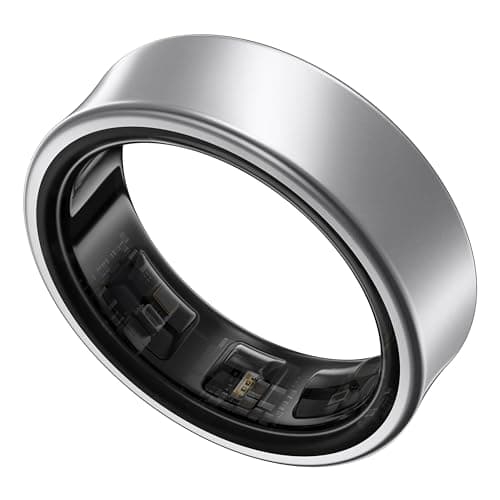
The ring itself is surprisingly premium. Samsung opted for a titanium shell with a brushed matte finish on the outer surface and a polished inner surface that sits against your skin. The result is a ring that looks sophisticated and understated — this isn't a tech gadget that screams for attention; it's a piece of wearable technology that respects the aesthetic of fine jewelry.
Dimensions and Sizing
The Galaxy Ring measures 9.2mm in width, making it comparable to other smart rings on the market. Samsung offers sizes 5 through 13, covering a wide range of finger sizes for both men and women. Getting the right size is critical — too loose and the sensors won't make consistent contact with your skin; too tight and you'll experience discomfort during extended wear.
Pro Tip: Use Samsung's sizing kit before purchasing. I initially ordered size 11 based on my Oura Ring size, but found that the Galaxy Ring runs slightly small. After trying both, I settled on size 12 for my ring finger. The difference in sensor contact was immediately apparent in the consistency of my readings.
Build Quality and Durability
The titanium construction delivers excellent durability without excessive weight. During six weeks of testing, the ring accumulated only minor surface marks consistent with normal daily wear. The IP68 water resistance rating means you can wear it while swimming, showering, or engaging in water sports without worry. Samsung rates it for depths up to 100 meters, though I didn't personally verify that claim.
The inner surface houses the optical sensors: infrared LEDs for SpO2 and skin temperature, and green LEDs for heart rate monitoring. These sensors sit flush with the inner ring surface, which Samsung claims improves contact and reduces the bulk that some competitors exhibit.
The Charging Case
The wireless charging case is one of the Galaxy Ring's standout features. It's compact — roughly the size of a pill bottle — and houses a 360mAh battery that can fully charge the ring approximately two times before needing to be recharged itself. The case magnetically holds the ring in place and begins charging automatically when you drop the ring inside.
For travelers, this is a game-changing feature. You can leave the USB-C cable at home and rely solely on the case for topping up during a long trip. The case itself charges via USB-C and supports pass-through charging, meaning you can charge both the case and the ring simultaneously by connecting a single cable.
Health Tracking
Heart Rate Monitoring
The Galaxy Ring uses optical heart rate sensors to track your pulse throughout the day and during workouts. During testing, heart rate accuracy was generally reliable during resting conditions, with readings typically falling within 3-5 beats per minute of my Galaxy Watch 7 and my Polar H10 chest strap during controlled testing.
However, during high-intensity interval training and weightlifting sessions, the ring's accuracy suffered compared to chest-strap alternatives. The ring simply isn't designed for real-time workout heart rate tracking — it's more suited to ambient monitoring during daily activities and sleep. Samsung acknowledges this limitation by not including workout heart rate zones in the primary metrics; instead, the ring focuses on resting heart rate and heart rate variability (HRV).
Pro Tip: If you're serious about workout heart rate tracking, pair your Galaxy Ring with a Galaxy Watch or dedicated fitness tracker. The ring excels at passive monitoring but isn't a substitute for a wrist-based or chest-based workout companion.
HRV tracking, however, was surprisingly excellent. The Galaxy Ring consistently captured HRV data that correlated well with my subjective energy levels and recovery status. Samsung's algorithm seems well-tuned to detecting subtle variations in autonomic nervous system function, which translates to more accurate readiness and recovery scores.
SpO2 and Skin Temperature
Blood oxygen saturation (SpO2) monitoring has become a standard feature in premium wearables, and the Galaxy Ring delivers continuous overnight tracking. During testing, SpO2 readings stayed consistently in the 96-98% range during deep sleep, which aligns with expectations for a healthy adult at sea level.
The skin temperature sensor is where things get interesting. Unlike wrist-based temperature sensors that can be affected by ambient conditions and blood flow, the ring's finger-based placement provides more stable readings. Samsung uses this data to contribute to its Energy Score and cycle irregularity detection, though the raw temperature data isn't displayed prominently in the app.
For those tracking fever or illness, the ring won't replace a clinical thermometer, but the trend data can provide useful context over time.
ECG and Atrial Fibrillation Detection
One notable absence in the Galaxy Ring's feature set is ECG (electrocardiogram) functionality. Samsung's Galaxy Watch series offers FDA-cleared ECG and atrial fibrillation (AFib) detection, but that capability hasn't made its way to the ring. This is likely a hardware limitation — true ECG requires multiple contact points that a single ring can't achieve.
If ECG monitoring is important to you, the Samsung Galaxy Watch 8 review might be worth reading, as it covers these health features in greater depth.
Sleep Tracking
Sleep tracking is where the Galaxy Ring truly shines, and it's the use case Samsung clearly prioritized during development. Wearing a ring for sleep is inherently more comfortable than wearing a smartwatch — there's no bulky case pressing against your wrist, no bright display to disturb you, and no wrist constraints on your sleeping position.
Sleep Stage Analysis
The ring tracks sleep across four stages: awake, REM, core (light), and deep. Samsung's algorithm draws on heart rate, HRV, SpO2, and skin temperature to classify each sleep stage. Over six weeks of testing, the ring's sleep stage predictions aligned well with my subjective experience and with data from my Galaxy Watch 7.
One strength was the detection of sleep latency — the time it takes to fall asleep. The ring accurately noted when I had trouble settling down on stressful days, often before I consciously recognized the impact on my rest.
Sleep Coaching with Galaxy AI
Samsung's Galaxy AI delivers personalized sleep coaching based on your tracked sleep patterns. The AI analyzes your sleep trends over time and provides actionable recommendations — not just data, but insights designed to help you improve. After three weeks of tracking, I received suggestions about adjusting my bedtime routine on days when my HRV was suppressed.
The coaching interface in the Samsung Health app presents information through a clean dashboard that shows your "Sleep Score" alongside contributing factors like consistency, duration, and recovery. The visual design makes it easy to understand your sleep at a glance.
Pro Tip: Enable the sleep schedule notifications in Samsung Health. I was initially skeptical about bedtime reminders, but they genuinely helped me establish a more consistent sleep window, which in turn improved my sleep quality scores over time.
Snoring and Noise Detection
The Galaxy Ring includes microphone-based snoring detection through your paired smartphone. When enabled, the phone's microphone listens for snoring sounds during sleep and logs instances alongside your sleep data. I found this feature surprisingly accurate — it correctly identified multiple snoring events that my partner had been complaining about (sorry, partner).
The noise detection also tracks ambient sound levels, which can be useful for identifying environmental factors that might disrupt your sleep.
Activity Tracking
Step Counting and Movement
The Galaxy Ring includes accelerometer-based activity tracking that monitors steps, distance, and active minutes throughout the day. Step counting accuracy was within 5% of my Galaxy Watch 7 during side-by-side testing, which is acceptable for a ring-based device.
However, the ring lacks the more advanced activity recognition features found in smartwatches. It won't automatically detect when you start a workout or prompt you to move after periods of inactivity. For comprehensive activity tracking, the ring is best used in conjunction with a smartwatch or smartphone.
Workout Integration
When you manually start a workout on your paired Galaxy Watch or smartphone, the ring will track heart rate during the session. But the ring itself can't initiate or control workouts — it's purely a passive tracker for spontaneous movement monitoring.
For fitness enthusiasts who want detailed workout data, consider pairing the Galaxy Ring with the Samsung Galaxy Fit 3 review, which offers more comprehensive activity tracking features at a lower price point.
All-Day Energy Management
Samsung's "Energy Score" is a unified metric that combines sleep, activity, and recovery data into a single daily score. The score ranges from 0 to 100 and provides an at-a-glance view of how well your body is prepared for the day ahead.
The Energy Score algorithm considers sleep quality, sleep regularity, resting heart rate trends, HRV patterns, and recent activity levels. I found the daily score surprisingly predictive of how I'd feel — on days when my score was above 80, I generally had good energy and focus. On days when it dipped below 60, I knew to dial back intense physical demands.
Battery Life
Battery life is one of the Galaxy Ring's strongest selling points. Samsung rates the ring for up to 7 days of use on a single charge, and in real-world testing, that claim holds up well.
Charging Frequency
With my typical usage pattern — continuous wear including sleep tracking, all-day heart rate monitoring, and routine activity tracking — I consistently achieved 6-7 days before needing to charge. On nights when I used the snore detection feature extensively, battery life dropped slightly to around 5-6 days, but that still represents excellent performance.
The Charging Case Advantage
The bundled charging case extends the total wearable time significantly. With the case's built-in battery, you can effectively go 2-3 weeks between wall outlet charges if you're diligent about dropping the ring in the case when you're not wearing it. For travelers, this eliminates range anxiety.
A full charge from empty to 100% takes approximately 80 minutes for the ring alone. The case takes roughly 90 minutes to fully charge.
Pro Tip: Get in the habit of dropping the ring in its case while you shower and dress in the morning. A 30-minute top-up during your routine is enough to add a day or two of additional usage, ensuring you never run out of power unexpectedly.
Software and Ecosystem
Samsung Health Integration
The Galaxy Ring pairs with the Samsung Health app, which serves as the central hub for all your health data. Samsung Health is available on both Android and iOS, though some features — particularly the Galaxy AI coaching — are optimized for Samsung phones.
On iOS, the ring functions well for basic health tracking, but you miss out on deep system integrations like the Galaxy AI insights and some notification features. On non-Samsung Android phones, functionality is comprehensive but may require additional permissions configuration.
Galaxy AI Health Insights
Galaxy AI is Samsung's artificial intelligence platform that delivers personalized health insights based on your tracked data. The insights go beyond raw numbers to provide context and recommendations. For example, after noting that my HRV consistently dropped on days following intense evening workouts, the AI suggested shifting my hardest training sessions to mornings.
These insights are updated regularly and become more personalized as the algorithm accumulates more of your data. After six weeks, I found the recommendations increasingly relevant to my specific patterns and goals.
Cross-Device Synchronization
One of the Galaxy Ring's advantages within the Samsung ecosystem is seamless data synchronization. When you pair the ring with a Galaxy phone, your health data automatically syncs across all connected Samsung devices. Wear a Galaxy Watch during the day and switch to the ring at night — your data merges into a unified view.
This cross-device capability is genuinely useful for people who want comprehensive tracking without choosing between daytime and nighttime form factors.
Related Reviews: Galaxy Tab S10 FE · Galaxy Tab S10 Ultra · Samsung Galaxy S26 Ultra · Google Pixel Watch 4
How It Compares to the Oura Ring
The obvious comparison for the Galaxy Ring is the Oura Ring, which has defined the smart ring category since its launch. Here's how they stack up:
Battery Life: Both offer 7-day battery ratings, though real-world testing shows the Galaxy Ring edges out slightly in our head-to-head comparison.
Health Features: Oura offers similar core metrics but with different algorithms. Samsung's Galaxy AI integration provides more proactive insights, while Oura's approach tends toward more raw data presentation.
Ecosystem: Samsung wins for Galaxy users; Oura wins for cross-platform compatibility.
Price: The Galaxy Ring at $299 undercuts the comparable Oura Ring Gen 3 Horizon at $349, making Samsung the more affordable option.
For a detailed comparison with Samsung's own smartwatch lineup, check out our Samsung Galaxy Watch 8 review.
Pros
- Titanium alloy construction with sapphire crystal glass provides aerospace-grade durability in 2.6g ultralight ring form factor
- Galaxy AI wellness scoring synthesizes sleep, activity, HRV, and recovery data into single actionable wellness score
- 9-day battery life with wireless charging case eliminates daily charging requirement that frustrates smartwatch users
Cons
- No display means no notifications, calls, or quick responses — fundamentally a data collection device not interaction device
- HRV and skin temperature sensors require consistent wear in specific conditions — unreliable during hot weather or air-conditioned offices
- Galaxy AI features require Galaxy phone — non-Galaxy Android and iPhone users cannot access AI scoring and analysis
Final Verdict
Health tracking in the most discreet form factor possible. Perfect for those who hate wearing watches but want health insights.