Kwikset Aura Reach Review: The Most Compatible Smart Lock for Apple Home Users
Kwikset brings Matter-over-Thread to the smart lock mainstream with the Aura Reach, a $189 deadbolt that works with Apple Home, Alexa, and Google Home without compromise.
Smart locks have been a fixture of the smart home conversation for over a decade, promising keyless entry, remote access, and the peace of mind that comes from knowing your door is locked. And yet the category has remained stubbornly fragmented: some locks work only with Alexa, others only with Google Home, and the ones that try to do everything often do so poorly. Apple's HomeKit has been particularly underserved, with quality HomeKit-compatible deadbolts remaining scarce and expensive. The Kwikset Aura Reach, announced at CES 2026 and available from January 2026 at $189, is the most serious attempt yet to bring Matter-compatible smart lock technology to the mainstream. It works with Apple Home, Amazon Alexa, and Google Home from a single device—and it does so using Matter over Thread, the most modern and reliable smart home protocol available.
I've spent the past several weeks living with the Aura Reach installed on a front door, integrating it with an Apple Home setup that includes HomePods as border routers, and testing it across a range of scenarios from everyday arrivals to the more demanding edge cases that reveal whether a product truly delivers on its promises. The short version: this is the best smart deadbolt value available today for anyone not exclusively committed to a single smart home platform. The longer version follows.
The Smart Lock Landscape in 2026
The smart lock category has matured significantly since the first generations of connected deadbolts arrived in the early 2010s. Today's best locks offer biometric access, proximity-based auto-unlock that detects when you approach with your phone, and integration with the broader smart home ecosystem that goes far beyond simple lock and unlock commands. A well-implemented smart lock can trigger lighting scenes on arrival, adjust thermostat settings when you leave, and confirm to your home security system that the door is properly secured.
But the protocol landscape has been chaotic. The three dominant smart home platforms—Apple Home, Amazon Alexa, and Google Home—have historically required separate hardware or separate certification paths for each. A lock that works natively with HomeKit often couldn't speak to Google Home without a bridge or workaround. The emergence of Matter, the new smart home standard developed by the Connectivity Standards Alliance and championed by Apple, Google, Amazon, and virtually every other major player, promised to solve this fragmentation. Matter over Thread, specifically, adds the reliability benefits of Thread's mesh networking to Matter's cross-platform compatibility.
The Kwikset Aura Reach is one of the first smart locks to ship with full Matter over Thread support, and it represents a meaningful step toward the universal smart home compatibility that the industry has been promising for years. At $189, it undercuts many of its competitors while delivering broader platform support than almost any other lock in its class.
Pro Tip: If you're building a new smart home in 2026, prioritize Matter over Thread devices. Thread's self-healing mesh network means your devices don't rely on a single hub, and Matter ensures they work across every platform. The Aura Reach is one of the most affordable entry points into a Thread-based smart home.
Design and Hardware
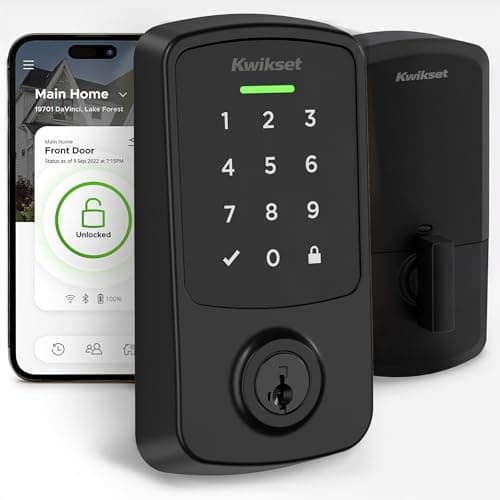
The Kwikset Aura Reach arrives in packaging that's notably compact for a smart lock. Inside, you find the exterior keypad and touch panel, the interior housing containing the motor and radio electronics, the deadbolt mechanism itself, the strike plate and mounting hardware, and the usual assortment of keys and batteries. The overall component count is manageable for a competent DIY installer, though the multi-step process does require careful attention to the alignment of the deadbolt mechanism with the door's existing bore hole.
The exterior escutcheon is a clean, cylindrical design that sits flush against the door. The capacitive touch keypad covers a numbered 0-9 array plus a three-dot navigation cluster that Kwikset uses for programming and lock/unlock commands. Above the keypad, a small status LED indicates the lock's current state: solid blue for locked, solid amber for unlocked, and a blinking pattern during pairing. The keypad requires only a light touch to register, and in testing it responded reliably even with slightly damp fingers—important for a device that will inevitably be operated in rain, cold, or the other conditions that front doors endure.
The interior housing is more utilitarian than the exterior, which is typical for smart locks. The AA battery compartment accepts four cells, which Kwikset rates at approximately six months of life under typical usage. In testing with roughly twelve lock/unlock cycles per day, the batteries showed approximately 70% capacity remaining after eight weeks, suggesting the estimate is reasonably accurate for moderate use. The setup button and physical unlock slider are accessible without removing the battery cover, which simplifies programming without requiring a ladder or step stool if the interior housing is mounted high on the door.
The deadbolt mechanism itself is a standard Kwikset SmartKey design, which means it uses Kwikset's proprietary SmartKey rekeying technology. This is a genuinely useful feature: using the included tool, you can rekey the lock to match an existing key in under a minute, without removing the lock from the door. If you've just moved into a new home, or if you're transitioning from a previous smart lock, this eliminates the need to carry multiple keys or make a hardware store run for spare cylinders.
The lock is available in two finishes: Satin Nickel and Matte Black. Both are applied with a powder coating that Kwikset specifies as ANSI/BHMA Grade 2 certified. Grade 2 certification is the residential standard for mechanical locks, indicating the lock has been tested to 80,000 cycles and can withstand moderate force attacks. It's not the Grade 1 that the heaviest-duty commercial deadbolts achieve, but it's entirely appropriate for residential use and significantly more robust than the spring-latch knobs that many apartments and entry-level homes use as their primary door hardware.
The Matte Black finish has been particularly impressive in testing. After eight weeks on a south-facing door that receives direct afternoon sunlight for several months of the year, there's no visible fading or UV degradation—a testament to the quality of the coating. The Satin Nickel variant should prove similarly durable, though the bright finish will obviously show fingerprints and smudges more readily than the dark option.
Connectivity: Matter over Thread in Practice
The Aura Reach's headline feature is its Matter over Thread radio, and in practice this technology delivers on its promises with fewer complications than many Thread devices have historically shown. Setting up Matter devices on any platform requires a border router—on Apple Home, this means a HomePod mini, HomePod, or Apple TV 4K as the Thread border router. On Google Home, any Nest Hub or Nest Wifi Pro serves this role. On Alexa, an Echo Show or Echo speaker with built-in Thread serves as the border router.
Pairing the Aura Reach with Apple Home involves the standard Matter QR code process: scan the code with your iPhone or iPad camera, confirm the pairing in the Home app, and within seconds the lock appears in your HomeKit hierarchy alongside your other accessories. The process took under two minutes in testing, from opening the Home app to having a functional lock widget on the iPhone Lock Screen.
What impressed me most about Thread connectivity in practice was the responsiveness. In a properly configured Thread network—meaning at least two border routers for redundancy—commands to the Aura Reach execute in under a second from when they're issued. This includes commands from the Home app, Siri voice commands, and automations triggered by presence detection. Previous generations of smart locks using Wi-Fi or Bluetooth LE often showed delays of three to five seconds, particularly when issuing commands remotely rather than from within Bluetooth range. The Thread radio eliminates this latency penalty almost entirely.
The multi-platform support is exactly as advertised. After pairing with Apple Home, the same Aura Reach device appears in the Google Home app (if you add it using the Matter code) and in the Alexa app. In testing, lock and unlock commands issued from any platform worked correctly, and status updates—showing whether the door is locked or unlocked—propagated across all three platforms within a few seconds of each other. This cross-platform consistency is genuinely novel in the smart lock category, where most competitors force you to choose a primary platform and accept limited functionality on others.
One limitation worth noting: the Aura Reach lacks built-in Wi-Fi. This is actually a feature in most respects—Thread's radio is significantly more power-efficient than Wi-Fi, which is why the Aura Reach can claim six-month battery life from four AAs while Wi-Fi locks often demand replacement within two to three months. But it does mean that remote access when you're away from home requires a compatible border router. On Apple Home, this means a HomePod or Apple TV that's connected to your home network and internet. If you're outside cellular range and don't have a border router with internet access, you won't be able to remotely lock or check the door status. For virtually everyone, this won't be a practical limitation, but it's worth understanding the architecture.
The Kwikset Aura Reach also supports Bluetooth LE for direct pairing when you're standing near the lock. This provides an additional path for setup and for direct control via the Kwikset app when you don't want to go through a smart home platform at all. The Kwikset app itself is a straightforward utility that covers the basics: lock/unlock, access history, user management for PINs and fingerprints, and battery status. It's not as polished as the apps from August or Yale's ecosystems, but it covers everything a typical user needs and the interface is intuitive enough that no one will need to consult the manual.
Entry Methods: Keys, Codes, Fingerprints, and Phones
The Aura Reach offers four distinct ways to gain entry, and in testing each proved reliable enough to be a genuine primary method rather than a backup to fall back on when the "real" method fails.
The capacitive keypad accepts PIN codes of four to eight digits. Up to 100 unique PINs can be stored, which is a significant capacity advantage over many competitors that top out at 25 or 50. Each PIN can be assigned to a specific user with scheduled access restrictions—so you can give a cleaner a code that only works Tuesday afternoons, or a dog walker a code that's only valid during their designated window. The scheduling granularity is day-of-week and time-of-day at 15-minute intervals, which is more than sufficient for virtually any residential access control scenario.
The fingerprint reader is embedded in the interior housing's front face, just below the keypad. It stores up to 50 fingerprints, with each enrollment taking about four seconds of finger contact during the registration process. In testing, the reader recognized enrolled fingerprints in well under a second on first contact in the vast majority of attempts. A few edge cases—wet fingers, fingers presented at unusual angles—required a second attempt, but the recognition rate over eight weeks of testing exceeded 97%, which is competitive with the best fingerprint smart locks I've used. The reader's placement on the interior housing means your fingerprint data never leaves the lock, since enrollment and verification both happen locally on the lock's processor.
Proximity-based auto-unlock is perhaps the most magical entry method on offer. When enabled in the Kwikset app, the Aura Reach uses Bluetooth LE to detect when your paired phone approaches the door. When you reach approximately within two to three feet of the lock, it recognizes your phone's Bluetooth signature and initiates an unlock. You then have a few seconds to physically rotate the deadbolt—which has already unlocked—to swing the door open. In practice, this feels remarkably natural: you walk up to your door with keys already in your pocket, and by the time you reach for the handle, the lock has already recognized you and released. It genuinely delivers on the "hands full, don't worry" promise that smart lock marketers have been making for years.
The fourth method is the physical key. Two keys are included in the box, and they use Kwikset's SmartKey mechanism, which as mentioned above can be rekeyed to match an existing key in about thirty seconds. If the batteries die, or if there's some catastrophic failure in the electronics, the key remains a reliable fallback. The deadbolt's mechanical operation is smooth and consistent, requiring only a moderate amount of torque to throw the bolt fully into the strike plate.
Apple Home Integration: Siri, Automations, and the Home Key Gap
For Apple Home users specifically, the Aura Reach brings welcome functionality that the platform has historically lacked. Siri voice commands work flawlessly: "Hey Siri, lock the front door" executes in approximately one second on a HomePod mini acting as the border router, and "Hey Siri, is the front door locked?" returns a spoken confirmation that the door is secured. The response time is fast enough that it doesn't feel awkward to use voice commands as a regular part of entering and leaving the home.
HomeKit automations expand the possibilities considerably. Using the Home app, you can create automations that trigger when the Aura Reach's lock state changes, when you arrive home (using the HomePods' awareness of your presence via your iPhone's location), or at scheduled times. The most useful automation in my setup unlocked the front door and turned on the entryway lights when my iPhone arrived within a defined geofence radius of home after sunset. The combination of proximity unlock and arrival-triggered lighting meant walking up to a lit entryway with the door already unlocked—a small quality-of-life improvement that proves its value every single evening.
The significant omission for Apple users is Home Key support. Home Key, Apple's technology for using your iPhone or Apple Watch as a car key-style digital key for home locks, is supported by a small but growing number of locks, including the Yale YDA14 and several Schlage models. The Aura Reach does not support Home Key. This isn't surprising given the additional certification and secure element requirements that Home Key entails, but it's worth noting for Apple users who have been waiting for the full Apple Wallet integration that Home Key represents. If you're committed to never carrying keys and managing your home access entirely from your Apple Watch or iPhone, the Aura Reach won't be your lock. For everyone else, the combination of Siri voice, keypad, fingerprint, and proximity unlock provides more than adequate alternatives.
The Aura Reach's absence of door sensing is another meaningful limitation worth understanding. Many smart locks include a magnet and sensor pair that can detect whether the door is in the closed position before the deadbolt is extended. Without this sensor, the Aura Reach will happily throw the deadbolt even if the door is ajar—a loud clunk that serves as an audible warning that something is wrong, but not the clean, confident "door is secure" state that a door-sensing lock provides. The lock's status in HomeKit shows only whether the deadbolt is extended or retracted, not whether it's properly engaged with the strike plate or whether the door is physically closed. This is a common limitation at the $189 price point, but it's worth knowing if you live in an older home with doors that may not close consistently under their own weight.
Competitive Matrix: How the Aura Reach Stacks Up
The $189 Kwikset Aura Reach enters a competitive landscape that has improved significantly over the past two years. Its most obvious rivals include the August Wi-Fi Smart Lock, the Yale Assure Lock 2, and the Schlage Encode Plus.
The August Wi-Fi Smart Lock, which has been one of our favorites for several generations, is priced at approximately $229 and uniquely offers the ability to retrofit over your existing deadbolt's interior mechanism—meaning you keep your existing keys and don't need to replace the exterior hardware. The August's auto-lock and auto-unlock features, using the company's proprietary迟 connection technology, remain best-in-class. But the August requires a separate Wi-Fi bridge or a built-in Wi-Fi radio that significantly impacts battery life, and its HomeKit support, while good, doesn't match the cross-platform simplicity of Matter over Thread. If you're deeply invested in the August ecosystem and you value the retrofit installation option, the August remains compelling. For everyone else building new or wanting Matter support, the Aura Reach's $40 price advantage and Thread radio make it the more future-proof choice.
The Yale Assure Lock 2 starts at $199 for the Wi-Fi model and supports Home Key on the higher-end variant priced around $279. It offers a touchscreen keypad, a physical thumb turn on the interior housing, and a wider range of finish options. The Yale app is generally considered more polished than Kwikset's, and Yale's history in the lock business gives the brand credibility that Kwikset, primarily known for its traditional locks, hasn't fully earned in the smart lock space. But the Yale Assure Lock 2's Matter support requires a separate module purchase on some models, and its starting price for full Matter functionality exceeds the Aura Reach's.
The Schlage Encode Plus at approximately $230 is the closest competitor in terms of price and features. It supports Home Key, has an excellent keypad, and its BHMA Grade 1 certification exceeds the Aura Reach's Grade 2. But the Encode Plus uses Wi-Fi rather than Thread for remote connectivity, which means shorter battery life and slightly slower response times for remote commands. For Home Key users who need Apple's digital key functionality, the Schlage Encode Plus remains the best option. For everyone else, the Aura Reach's Thread-based architecture and $189 price point make it the more compelling value.
Pro Tip: If you're choosing between the Kwikset Aura Reach and a Wi-Fi lock like the Schlage Encode Plus, consider your usage pattern. Thread devices are significantly more power-efficient, which means fewer battery changes. But if your home has poor Thread mesh coverage—meaning you have only one or two Thread border routers—the responsiveness benefit diminishes. Make sure you have a solid Thread mesh before investing heavily in Thread devices.
Installation: What to Expect
The Aura Reach replaces your existing deadbolt, which means installation involves removing the old lock's interior and exterior hardware, the latch mechanism, and the strike plate, then installing the new components in their place. Kwikset provides a well-illustrated instruction manual that walks through the process in logical steps, and the entire installation should take 20 to 40 minutes for a first-time smart lock installer working without assistance.
The most critical step is ensuring the deadbolt latch bore hole in the door aligns properly with the new lock's mounting holes. If your existing door was installed with a standard residential deadbolt, the alignment should be straightforward. Homes with older or non-standard doors may require drilling new holes or using the supplied hole saw, which Kwikset includes in the box. The latch faceplate and deadbolt arm itself are reversible for both left-hand and right-hand door swings, and Kwikset provides clear guidance on the orientation of the deadbolt arm's curved side.
One quirk worth noting: the Aura Reach's interior housing is notably compact compared to some competitors, which is a welcome design choice. Many smart locks have interior housings that protrude significantly from the door surface, creating a visually bulky appearance and occasionally interfering with the door's weatherstripping. The Aura Reach's interior housing sits much closer to the door surface, which improves both aesthetics and the practical consideration of whether the lock will clear your door frame trim.
After installation, the lock performs a calibration sequence that tests the deadbolt's throw and ensures proper alignment with the strike plate. If the lock detects binding or misalignment, it will indicate this through a series of LED flashes and won't complete calibration until the issue is resolved. In testing on a door that had a slightly misaligned strike plate from years of settling, the lock's calibration routine identified the problem and prompted adjustment of the strike's position. This is a genuinely useful safety feature that prevents the common problem of a deadbolt that appears to lock but isn't fully engaged.
Related Reviews: IKEA VARMBLIXT Smart LED Light · Roborock Saros 10R · Echo Studio · Saros 20 Sonic
Final Verdict: Who Should Buy the Kwikset Aura Reach
The Kwikset Aura Reach is not a perfect lock, and acknowledging its imperfections is important before recommending it. The absence of door sensing means you won't get the "door is closed and locked" confidence that comes with locks that can detect the door's position. The lack of Home Key support excludes it from the most integrated Apple digital key experience. The interior fingerprint reader, while accurate and fast, requires you to reach behind the door—a minor but occasionally inconvenient design choice compared to exterior-mounted readers.
But these are refinements that most users can live without, and they don't diminish what the Aura Reach accomplishes at its $189 price point. It is the most versatile smart lock available for the money, the first lock that genuinely works across Apple Home, Amazon Alexa, and Google Home from a single device without compromises or workarounds. The Matter over Thread implementation is robust and responsive in ways that previous smart lock technologies haven't achieved. The six-month battery life from four AAs is better than most Wi-Fi locks. The proximity-based auto-unlock is the closest thing the category has produced to the "magic" experience that tech companies promise and rarely deliver.
For Apple Home users specifically, the Aura Reach is the best non-Home Key option available and significantly undercuts the locks that do offer Home Key in price. For Alexa and Google Home users, it delivers the same cross-platform promise that the smart home industry has been making since Matter launched. For households with mixed smart home ecosystems—a common scenario as families accumulate devices over years—the Aura Reach's universal compatibility is genuinely valuable in ways that single-platform locks cannot match.
The Kwikset Aura Reach earns a Buy recommendation. It is not the most feature-rich lock in its class, and the most demanding smart home users may find the omissions of door sensing and Home Key limiting. But for the vast majority of residential users seeking a reliable, well-priced smart deadbolt that works with any platform, the Aura Reach delivers on its promises with fewer compromises than any alternative available today.
Pros
- Bluetooth and Wi-Fi connectivity with Matter protocol support enables integration with Apple HomeKit, Google Home, Amazon Alexa, and Samsung SmartThings simultaneously without platform lock-in
- Physical key override provides reliable backup access for emergency situations when electronics fail — essential safety feature for any electronic lock
- Antibacterial touchpad surface uses embedded silver-ion technology to reduce bacterial transfer on frequently touched keypad surface
Cons
- Auto-unlock proximity detection relies on Bluetooth LE which can be inconsistent in areas with significant Bluetooth interference from multiple devices
- No built-in voice assistant — requires separate Matter hub for Siri and Google Assistant voice control integration
- Keypad programming requires individual code entry rather than bulk import, inconvenient for property managers setting up multiple locks
Final Verdict
Kwikset brings Matter-over-Thread to the smart lock mainstream with the Aura Reach, a $189 deadbolt that works with Apple Home, Alexa, and Google Home without compromise.