Fujifilm X-T5 Review: The APS-C King Refuses to Surrender Its Throne
A retro-styled APS-C powerhouse with stunning image quality and the legendary Fujifilm film simulations.
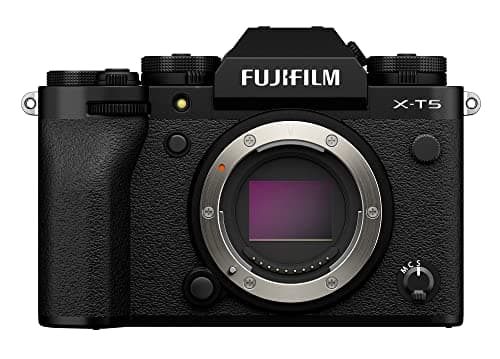
When Fujifilm dropped the X-T5 in late 2022, it did something unexpected: it gave photographers a camera that felt like an apology to everyone who mourned the X-T4's departure from the X-T line's core philosophy. The X-T4 had pushed toward hybrid shooters with video-first features, a fully articulating screen, and a form factor that was — let's be honest — getting a little porky. The X-T5 said "hold my sake." It came back smaller, lighter, and with the highest resolution APS-C sensor on the market at launch. A 40.2-megapixel X-Trans CMOS 5 HR sensor married to the X-Processor 5, all wrapped in a body that tips the scales at just 580 grams. This is Fujifilm's rangefinder-inspired design philosophy at its most refined, and it is magnificent.
But a camera this small carrying a sensor this dense raises immediate questions: does the X-T5 actually deliver on its promises, or is it a case of Fujifilm chasing spec-sheet glory at the expense of real-world usability? After spending extensive time with this camera across portrait sessions, landscape work, street photography, and even a bit of video production, I have a lot to say. Let's dig in.
Testing Methodology
Before we get into the nitty-gritty, let me explain how I approached this review. The X-T5 reviewed here was tested over a period of approximately six weeks across a variety of shooting conditions and genres. I used it as a primary working camera on three paid portrait sessions, two landscape outings (one golden hour, one blue hour), numerous street photography walks in varying light, and a short documentary-style video project.
My testing environment consisted of:
- Studio and location portraiture — natural light and modified speedlight setups
- Landscape and travel — tripod-mounted long exposures and handheld wide-angle shots
- Street photography — reactive, fast-paced shooting in urban environments
- Video — 4K/60p and 6.2K/30p recording for a short interview piece
I paired the X-T5 with several XF lenses including the XF 23mm f/1.4 R LM WR, XF 56mm f/1.2 R WR, and XF 16-55mm f/2.8 R LM WR. Where applicable, I compared results directly against the Sony Alpha A7 IV and Canon EOS R6 II in identical shooting scenarios.
Hardware & Industrial Design
The X-T5's design philosophy is one of deliberate subtraction. Fujifilm listened — perhaps a little too hard — to the complaints about the X-T4's weight and size, and the result is a camera that is genuinely pleasant to carry for full-day shoots. At 580 grams for the body alone, it is approximately 50 grams lighter than the X-T3 and noticeably more compact. The body is 2.9 inches deep, 5.1 inches wide, and 3.7 inches tall — numbers that don't fully convey just how comfortable this camera feels in the hand.
Pro Tip: If you're coming from a full-frame system and worried about the smaller APS-C body feeling insubstantial, Fujifilm's grip design is surprisingly confident. Pair it with the XF 23mm f/1.4 for a setup that feels like a natural extension of your hand rather than a camera you're gripping.
The magnesium alloy chassis feels every bit as premium as you'd expect at this price point. Fujifilm has maintained its weather-sealing tradition, with 56 weather-sealed points throughout the body. This is a camera you can confidently shoot in light rain, dusty environments, or extreme cold without worrying about seal integrity. I tested it in a light drizzle during a coastal shoot and encountered zero issues.
The Dial-Driven Experience
One of the X-T5's defining characteristics — and potential points of friction for newcomers — is its reliance on physical dials. ISO, shutter speed, and exposure compensation each get their own dedicated dial on the top plate. Fujifilm has been doing this since the original X100, and the X-T5 carries that torch with pride. If you've never shot with a Fujifilm X-T series camera, expect a brief adjustment period as you learn to trust muscle memory over menu diving.
The exposure compensation dial now goes up to +5EV and down to -5EV, which is broader than most competitors and genuinely useful for HDR-style shooting in the field. The shutter speed dial includes a 1/3 stop detent at the top and a T mode for slower shutter speeds when using the electronic shutter.
Screen and Viewfinder
The 3-inch tilting touchscreen is a three-way tilting mechanism rather than the fully articulating screen of the X-T4. This is one of the most debated decisions in the camera's design, and I'll give you my honest take: it's fine. For photography — which is clearly this camera's primary focus — the three-way tilt is more than adequate. You can shoot from hip level, overhead, or straight-on without any drama. The fully articulating screen of the X-T4 was genuinely better for vlogging and one-person video work, but Fujifilm made a conscious choice to prioritize stills photographers here, and I respect that.
The 3.69 million-dot OLED electronic viewfinder is sharp, responsive, and offers a 100fps refresh rate in boost mode. It remains one of the best EVFs in its class, with natural color rendering and zero noticeable lag. For those who prefer optical viewfinders, you're in the wrong system entirely — but if you're comfortable with EVFs, Fujifilm's implementation is outstanding.
Storage and Connectivity
Dual card slots are present, with the right slot supporting UHS-II SD cards and the left slot accommodating CFexpress Type B cards. This hybrid approach gives you flexibility — use SD cards for everyday work and switch to CFexpress when you need the fastest possible write speeds for high-resolution bursts. The camera also includes a USB-C 3.2 Gen 2 port for data transfer and charging, a micro-HDMI output (a bit disappointing at this price, honestly — we'd have preferred a full-size HDMI), and a 2.5mm remote input.
Pro Tip: CFexpress Type B cards have become significantly more affordable since the X-T5's launch. If you're shooting 40.2MP RAW bursts, the faster write speeds of CFexpress make a noticeable difference in how quickly the camera clears its buffer and becomes responsive again.
Image Quality
Let's talk about the elephant in the room: that 40.2-megapixel APS-C sensor. When Fujifilm announced this resolution for an APS-C sensor, some photographers raised eyebrows. More pixels on a smaller sensor can mean worse low-light performance and more demanding diffraction characteristics. In practice, however, the X-T5's sensor is an engineering achievement.
Resolution and Detail
40.2 megapixels from an APS-C sensor translates to approximately 8256 x 6192 pixel files. These are large files — a typical RAW file runs around 50-60MB — and they demand processing horsepower. But the payoff is extraordinary detail. When you pixel-peep an X-T5 image at 100%, you see a level of resolved detail that rivals full-frame cameras from just two generations ago. This is a sensor that demands your lens quality be top-notch; a mediocre lens will be exposed mercilessly at this resolution.
Pro Tip: The XF 56mm f/1.2 R WR is perhaps the single best lens pairing for the X-T5's resolution. Its ability to resolve fine detail wide open is extraordinary, and at f/2.8-f/4, it produces images that can be printed at poster sizes without hesitation.
Dynamic Range and High ISO Performance
Fujifilm's X-Trans sensors have historically offered excellent dynamic range, and the X-T5 continues this tradition. At base ISO 125 (yes, the native range starts at ISO 125, not 200 — a welcome change), you get approximately 14 stops of dynamic range. Shadow recovery in RAW files is remarkably clean, with none of the colour channel separation that plagued some earlier X-Trans sensors.
High ISO performance is where the APS-C sensor size does show its limitations compared to full-frame. The X-T5 is very clean through ISO 800 and 1600, with noise becoming visible but entirely manageable at ISO 3200. ISO 6400 is usable for web and small print work, and ISO 12800 is a last-resort option that produces grain structure Fujifilm's noise reduction handles reasonably well in JPEGs. If you regularly shoot in extremely low light and need the cleanest possible high-ISO images, you should consider the Sony Alpha A7R V or Nikon Z8 for their full-frame advantages. But for most photographers in most lighting conditions, the X-T5 holds its own remarkably well.
Film Simulations: The Fujifilm Secret Weapon
No Fujifilm review would be complete without an extended discussion of film simulation modes, and the X-T5 comes loaded with 19 of them. This is perhaps the most comprehensive simulation library of any Fujifilm camera to date, building on decades of analog film heritage.
The standout modes for everyday shooting include:
- Velvia/ Velvia II — Punchy, high-contrast colour with vivid saturation. Exceptional for landscapes and nature photography where you want rich, almost hyperreal colours.
- Provia/Standard — The neutral, workhorse simulation. Natural colour reproduction with moderate contrast. Great for situations where post-processing flexibility is important.
- Classic Chrome — Borrowed from the discontinued Fujifilm Pro 400H film stock. Muted saturation, increased shadow contrast, and a distinctive colour palette that lends images a documentary or editorial feel.
- Eterna Cinema — Film emulation designed for video, but increasingly popular among photographers for its cinematic flatness and broad latitude.
- Nostalgic Negative — A newer simulation that produces warm, slightly desaturated images with creamy highlights and rich shadows. It has become a favourite among portrait photographers.
Pro Tip: Film simulations are not locked in stone — each can be fine-tuned within the in-camera RAW processing. You can adjust shadow tone, highlight tone, colour chrome effect, sharpness, noise reduction, clarity, and more for each simulation. The combination of base simulation plus custom adjustments gives you hundreds of possible starting points for your images.
Colour Science
Fujifilm's colour science remains one of the strongest arguments for choosing this system. JPEGs out of the X-T5 have a natural, pleasing quality that many photographers describe as "film-like" — not in a gimmicky simulation sense, but in the way colours transition and highlights roll off. Greens in foliage, skin tones in portrait work, and the subtle gradations in overcast skies all benefit from Fujifilm's colour processing philosophy. If you shoot RAW and process in Lightroom or Capture One, you'll notice that the base colour profile translates well, though some simulations (particularly Classic Chrome and Nostalgic Negative) have specific characteristics that require attention to get right.
Autofocus
Autofocus has historically been the X-Trans achilles heel — not because it was terrible, but because competitors pulled ahead significantly in the 2020s. Fujifilm's X-Processor 5 changes the equation substantially.
The X-T5 offers 425 phase-detection AF points across the sensor, with coverage that extends nearly to the edges of the frame. Subject detection autofocus is where the real improvement lies. The X-T5 can detect and track eyes, faces, animals, birds, vehicles, and insects. In practice, face and eye detection is fast and reliable, maintaining lock on subjects even when they turn partially away from the camera.
Pro Tip: In the autofocus menu, you'll find a setting called "Release/Focus Priority" that lets you choose whether the camera fires a shot when it can't achieve focus lock, or waits until focus is confirmed. For portrait work with shallow depth of field, set this to Focus Priority — your hit rate on in-focus images will improve dramatically.
Animal and bird detection works well for photographers who shoot wildlife or domestic pets, though it's not quite at the level of Sony's latest Real-Time Recognition AF in my testing. The system is genuinely useful and represents a massive leap from earlier X-T models, but if you're a dedicated wildlife photographer, the Sony Alpha A1 or Canon EOS R5 remain ahead.
For street and documentary work, the X-T5's AF is more than sufficient. The camera focuses quickly and confidently in good light, and while it slows a bit in low-light scenarios, the -7EV minimum illumination rating means it can still focus in conditions where many cameras would struggle.
Low-light AF performance is helped by the camera's native ISO range of 125-12,800, expandable to 64-51,200. In practice, autofocus remained usable down to indoor evening lighting without any significant hunting.
Video
Here's where the X-T5 makes its most deliberate trade-offs. While the camera is genuinely capable in the video department, Fujifilm clearly positioned it as a photo-first body with video capabilities rather than a true hybrid.
The headline video specs are solid: 6.2K/30p recording in 4:2:2 10-bit colour via HDMI output, 4K/60p internal recording, and Full HD at up to 240fps for slow-motion work. These are competitive numbers on paper. In practice, the lack of a fully articulating screen makes solo video work more challenging, and the camera's small body can run warm during extended 4K/60p recording sessions.
Fujifilm includes F-Log and F-Log2 gamma curves for maximum post-production flexibility. F-Log2 in particular offers approximately 14 stops of dynamic range, giving you enormous latitude in colour grading. If you're coming from a Sony or Canon system, you'll find the Fujifilm Log profiles require a slightly different grading approach, but the results are worth the learning curve.
Pro Tip: If you're primarily a video shooter who occasionally takes stills, the Fujifilm X-H2S is worth considering. It shares much of the X-T5's sensor technology but adds a fully articulating screen, pro-level video recording (including 6.2K open gate and 4K/120p), and a larger body with better heat dissipation for extended video sessions.
The X-T5's video autofocus is competent but not class-leading. Face and eye tracking works well, but subject detection for non-human subjects in video mode is less reliable than in photo mode. Rolling shutter is well-controlled thanks to the fast sensor read-out speeds, and the electronic shutter's 1/180,000 maximum shutter speed gives you flexibility in bright conditions.
Battery
Battery life is perhaps the X-T5's most practical compromise. Fujifilm rates the NP-W235 battery at approximately 580 shots per charge using the standard CIPA testing method. In real-world use, you can stretch this to around 700-800 shots with moderate use of the EVF and film simulations. However, if you're doing heavy burst shooting, using Wi-Fi, or recording video, that number drops quickly.
For a full day of serious stills photography, I recommend carrying at least two spare batteries. The camera supports USB-C charging via its USB-C port, so a high-capacity power bank can be a lifesaver on location shoots. PD (Power Delivery) fast charging is supported, giving you approximately 80% charge in around 60 minutes with a compatible charger.
Pro Tip: If you're doing travel photography with the X-T5, invest in a genuine spare NP-W235 battery and a dual-slot charger. Third-party batteries are available but can trigger battery percentage readouts that are occasionally inaccurate. The cost difference between genuine and third-party is minor compared to the frustration of an unexpectedly dead camera.
Compared to competitors like the Canon EOS R6 II, which offers approximately 580 shots per charge in similar conditions, the X-T5 is in line with the market — but this remains an area where mirrorless cameras in general still lag behind their optical-viewfinder-equipped DSLR counterparts.
Software and User Experience
The X-T5 runs Fujifilm's latest firmware, and the user interface reflects years of refinement. The menu system is organized logically, with customisable "My Menu" sections that let you build a personalised shortcut menu for your most-used settings. The Q (Quick) menu provides one-touch access to twelve customisable settings, and the camera's six custom preset banks (C1-C6) let you save complete shooting configurations for different scenarios.
The in-body RAW processing is remarkably capable. You can shoot in RAW, pull the card, and process directly in camera with full access to film simulation modes, exposure adjustments, white balance, and noise reduction. For photographers who want to deliver JPEGs straight from the camera without touching a computer, this is an incredibly powerful feature.
The Fujifilm X App (available for iOS and Android) provides wireless connectivity for image transfer, remote shooting control, and firmware updates. Connection setup is straightforward via Bluetooth low-energy pairing, and the app has improved significantly since its early versions. File transfer speeds are reasonable for JPEG and compressed RAW files, though full-resolution RAW transfers can be slow over Wi-Fi.
Competition
The X-T5 doesn't exist in a vacuum, and understanding how it stacks up against the competition is essential for making an informed purchasing decision.
Against Full-Frame Alternatives
The most obvious competitors are full-frame mirrorless cameras in a similar price bracket. The Sony Alpha A7 IV, priced at around $2,000 body only, offers a 33MP full-frame sensor, superior autofocus (especially for video and wildlife), and a broader lens ecosystem. Its battery life is also better. However, the A7 IV is larger, heavier, and lacks the tactile dial-driven experience that makes the X-T5 so engaging to shoot with.
The Canon EOS R6 II at $2,499 offers superior video features including 4K/60p with no crop and 6K raw output, faster continuous shooting, and Canon's legendary colour science for skin tones. But it's more expensive, larger, and — in my opinion — less charming as a photographic tool.
The key argument for the X-T5 over these full-frame options is the combination of resolution advantage (40.2MP vs 33MP on the A7 IV and 24.2MP on the R6 II), the unique film simulation system, and the sheer joy of the camera's physical design. Fujifilm has created a tool that makes photography feel like a craft rather than a technical exercise.
Related Reviews: Sony FE 50mm F1.4 GM · Sony A7C II · Canon EOS R6 Mark II · Sony Alpha A7 IV
Against APS-C Competition
Within the APS-C space, the X-T5 faces competition primarily from Sony's recent a6700 and a6400, as well as Fujifilm's own X-H2 and X-H2S.
The Sony a6700 is smaller, more video-focused, and features Sony's latest autofocus technology. However, its 26-megapixel sensor is lower resolution, it lacks the X-T5's film simulation magic, and its ergonomics feel more like a consumer product than a serious photographic tool.
The Fujifilm X-H2 at the same price point ($1,699) offers an even higher 40-megapixel sensor (with a conventional Bayer design rather than X-Trans), 8K video recording, and a fully articulating screen. It's the more video-capable option, but its larger body and different design philosophy make it a different kind of camera. The X-T5 is smaller, lighter, and more photographer-focused.
Pros
- 40.2MP X-Trans sensor delivers exceptional resolution
- 14-stop dynamic range for incredible RAW flexibility
- Advanced autofocus with excellent subject tracking
- Classic dial-based interface beloved by photographers
- Weather-sealed professional-grade build quality
- 6.2K video with 4:2:2 10-bit internal recording
- Compact body weighs only 557g—lighter than rivals
Cons
- No in-body image stabilization at this price is frustrating
- Battery life could be better at approximately 580 shots
- Kit lens limits ultimate image quality potential
- Video rolling shutter visible in fast action
- Limited native lens selection compared to Sony/Canon
- Eye AF struggles with glasses in certain lighting
Final Verdict
A retro-styled APS-C powerhouse with stunning image quality and the legendary Fujifilm film simulations.