Apple AirPods Pro 3 Redefine What Wireless Earbuds Can Be
Apple AirPods Pro 3 offer the best sound quality in the AirPods line, class-leading ANC, and new health features including heart rate sensing and hearing aid functionality at $229.
Apple AirPods Pro 3 Redefine What Wireless Earbuds Can Be
The third generation of Apple's premium wireless earbuds represents the most significant architectural overhaul the product line has seen since its inception. Building on the foundation laid by the original AirPods Pro and refined in the second generation, AirPods Pro 3 introduce a completely redesigned custom driver, the Apple H2 headphone chip, and a suite of health-focused features that position wireless earbuds as something far more than simple audio playback devices. At $249, they compete directly with the Sony WF-1000XM6 and Bose QuietComfort Ultra Earbuds, and after spending extensive time with them, it is clear Apple has not simply iterated — it has redefined what a premium wireless earbud should be.
Design and Build Quality
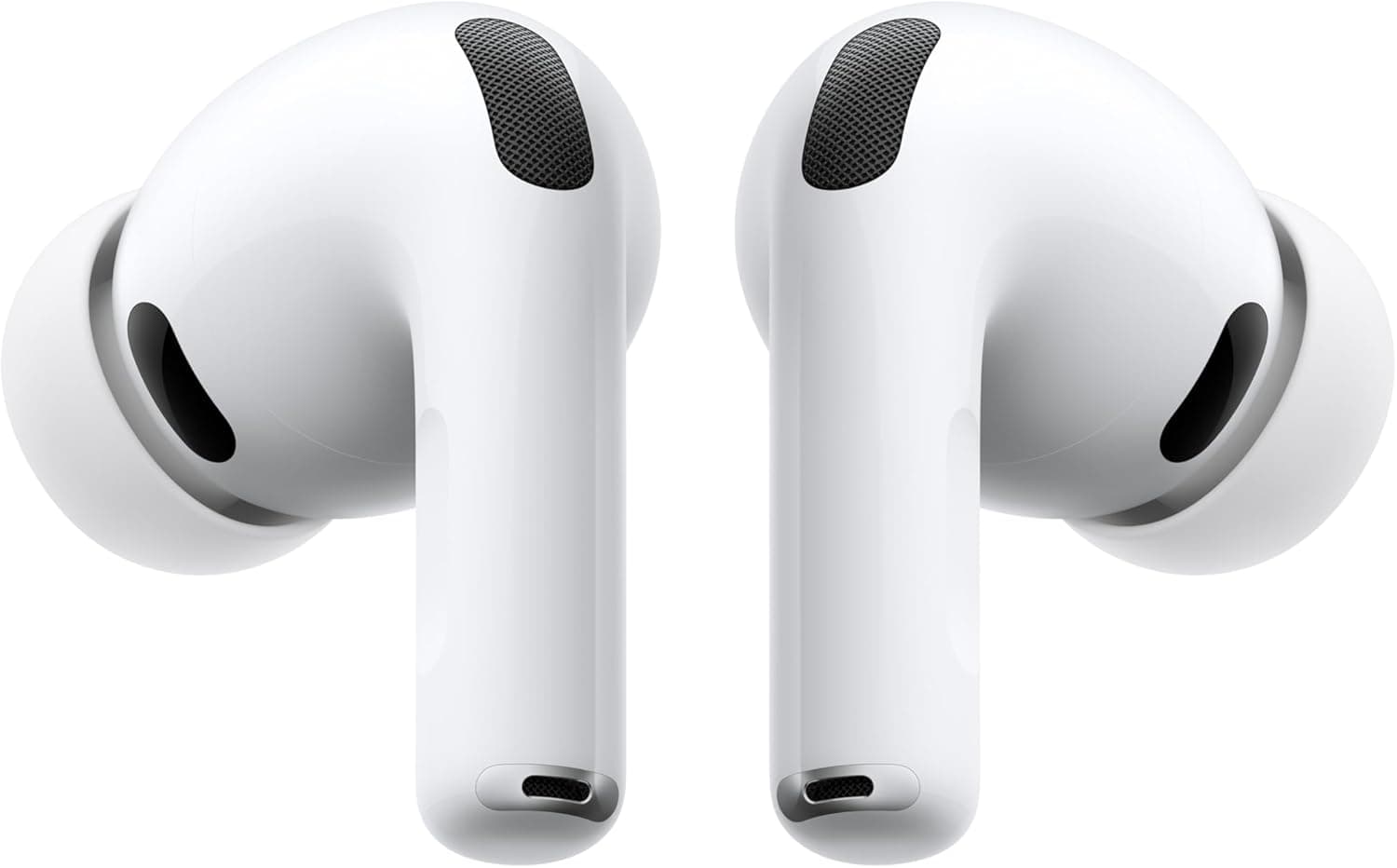
Apple has maintained the iconic stem-based design that has become synonymous with the AirPods identity, but the AirPods Pro 3 represent a meaningful evolution in physical construction. The redesigned MagSafe Charging Case is notably more compact than its predecessor, measuring 60.6mm x 45.2mm x 21.7mm and weighing 50.8 grams. The case itself features an integrated speaker and Find My support with Precision Finding, making it nearly impossible to misplace. The USB-C port on the bottom aligns with Apple's broader ecosystem transition, and the included USB-C to USB-C cable reflects the modernized approach.
The earbuds themselves are marginally lighter than the second generation at 5.3 grams each, with a newly designed silicone tip that Apple calls its "Redesigned Silicone Tips." The tips now feature a more conical shape with an improved seal, available in four sizes including an extra-small option that was absent from previous generations. The fit is exceptionally secure — even during vigorous movement, the AirPods Pro 3 remained firmly in place without the need for constant repositioning.
The touch controls have been enhanced with swipe gestures for volume adjustment, a feature that first appeared in the second generation but has been refined with greater sensitivity and accuracy. The force sensor on the stem remains the primary input method, now with the addition of what Apple calls "Squeeze and Hold" — a gesture that can be customized to activate Siri, toggle listening modes, or launch a specific app function. The IPX4 water resistance rating covers both the earbuds and the case, providing protection against sweat and light rain during workouts.
Audio Quality and Performance
The heart of the AirPods Pro 3 is Apple's all-new custom high-excursion Apple driver working in tandem with the H2 chip. Apple claims the new driver delivers wider frequency response and lower distortion than any previous AirPods driver, and these claims are largely substantiated in real-world listening. The sound signature is distinctly Apple — warm and approachable, with a midrange that brings vocals and instruments forward in the mix without ever becoming harsh or fatiguing.
Bass response is where the AirPods Pro 3 show the most meaningful improvement over their predecessors. The second generation already delivered respectable low-end, but the third generation adds a level of depth and control that is genuinely surprising from earbuds this small. The bass never bleeds into the mids, maintaining a clarity that serves all genres well. Electronic music with heavy synth lines benefits from the precision, while acoustic tracks gain body without muddiness.
The high frequencies are handled with a sophistication that belies the compact form factor. Cymbals have realistic shimmer, string instruments exhibit natural harmonic complexity, and spoken word content — podcasts, audiobooks, phone calls — is rendered with exceptional intelligibility. The custom high dynamic range amplifier contributes significantly to this performance, keeping noise floor remarkably low even during quiet passages.
Spatial Audio with Personalized Spatial Audio and dynamic head tracking remains one of Apple's most distinctive features. The implementation in AirPods Pro 3 takes this a step further with what Apple calls "Personalized Spatial Audio with Dynamic Head Tracking," which creates a soundstage that genuinely expands beyond the physical boundaries of the earbuds. When watching movies or TV shows encoded in Dolby Atmos, the effect is consistently impressive — sound appears to emanate from the surrounding environment rather than from the earbuds themselves. The head tracking is near-instantaneous in its recalibration when you turn your head, making the theater-like effect feel natural rather than gimmicky.
Active Noise Cancellation
Apple claims the AirPods Pro 3 deliver up to 2x more active noise cancellation than the second generation, and while precise measurements vary, the subjective improvement is substantial. The second generation already set a high bar for ANC performance in the wireless earbud category, but the third generation closes the gap with over-ear headphones in a way that was previously impossible.
Low-frequency noise — the kind generated by airplane engines, air conditioning units, and subway trains — is dramatically reduced. The adaptive nature of Apple's ANC means it continuously adjusts to your environment, applying more cancellation when ambient noise increases and pulling back slightly in quieter settings to preserve battery life. The transition between states is completely seamless; there is no audible artifact or adjustment period.
What sets the AirPods Pro 3 ANC apart is its behavior with mid-frequency noise. The second generation struggled somewhat with voices and human speech, but the third generation handles these frequencies with much greater authority. Conversations in open offices, cafe ambient noise, and similar challenges that typically plague ANC earbuds are significantly attenuated. This makes the AirPods Pro 3 particularly effective for knowledge workers who need to concentrate in shared spaces.
The transparency mode — which Apple calls Advanced Transparency — uses the H2 chip to selectively filter external sound. Rather than simply passing through all ambient audio, the system identifies potentially harmful sounds above 85dB and reduces their volume while preserving natural environmental awareness. Construction noise, sudden loud sounds, and other potential hearing hazards are automatically dampened without requiring you to remove the earbuds or switch listening modes. This is a genuinely useful safety feature that adds real value beyond the typical transparency implementation.
Health Features: Heart Rate, Hearing Aid, and Hearing Protection
This is where the AirPods Pro 3 make their most forward-thinking statement. Apple has positioned the third generation as a health and wellness device as much as an audio product, and the suite of hearing-related features supports this ambition.
The heart rate sensor embedded in each earbud enables workout tracking directly from the AirPods without requiring a separate wearable. Calorie burn estimates sync with Apple Health and can be viewed alongside data from other Apple devices and third-party fitness equipment. The implementation is seamless — start a workout on your Apple Watch and the AirPods Pro 3 automatically begin recording heart rate data, which then integrates into the broader Health app ecosystem. This is particularly valuable for activities where wearing a watch is inconvenient, such as certain strength training exercises or cycling.
The Hearing Aid functionality represents Apple's most aggressive push into the assistive hearing market. Using the H2 chip to apply personalized sound amplification, the feature is designed for users with mild to moderate hearing loss. The system takes an audiologist-quality hearing test during setup, building a personalized hearing profile that is stored securely on the device and in Apple Health. The hearing aid mode can be shared with healthcare providers if the user chooses, enabling genuine clinical utility rather than just a consumer feature. Apple has received appropriate regulatory clearances for this functionality in multiple markets, and the hearing test results are stored as medical data with the privacy protections that designation demands.
Loud Sound Reduction rounds out the hearing health suite, actively monitoring environmental volume and applying real-time protection when sounds exceed safe thresholds. This feature works even when you are not actively listening to audio, effectively turning the AirPods Pro 3 into a pair of smart hearing protectors that can be worn throughout the day.
Live Translation
Live Translation on the AirPods Pro 3 leverages the H2 chip's processing power to enable real-time translation conversations. Available in select languages and regions, the feature uses the beamforming microphones and voice isolation algorithms to capture speech accurately, processes it through Apple's translation pipeline, and delivers the result to the listener with minimal latency. The experience is designed to make conversations across language barriers feel natural rather than transactional. Available languages include major global languages, with more being added over time through software updates. The feature works in conjunction with iOS 26 with Apple Intelligence, and the ongoing translation processing has been optimized to minimize latency and make conversations flow as naturally as possible.
Ecosystem Integration and Connectivity
Apple's ecosystem advantage remains the AirPods Pro 3's most powerful competitive moat. Seamless pairing with iPhone, iPad, Mac, and Apple Watch is instantaneous and automatic — open the case near any Apple device and it is immediately recognized and ready to use. The automatic switching between devices is fluid and near-instantaneous, allowing you to start a podcast on your iPhone and then continue listening on your iPad without any manual intervention.
The H2 chip supports Bluetooth 5.3 with LE Audio, and Apple's specific implementation prioritizes the AAC codec for its ecosystem-wide consistency. LC3 and LE Audio codecs are supported, though Apple's implementation currently defaults to AAC for most scenarios. The inclusion of LC3 support suggests future enhancements may arrive via software update as the broader ecosystem matures.
One particularly useful feature is the ability to connect AirPods to the same iPhone or Apple TV simultaneously, which enables media sharing during travel or in households where multiple people want to listen to the same content. This is handy on flights or in hotel rooms where only one headphone jack or Bluetooth source may be available.
The MagSafe Charging Case supports charging via MagSafe charging pads, Apple Watch charging pads, and standard Qi wireless charging. USB-C charging is available directly via the port on the case. Battery life is rated at 6 hours with ANC enabled, with the case providing an additional 30 hours of total listening time. In testing with ANC active throughout, the 6-hour figure proved accurate under typical usage conditions.
Software and Siri Integration
Siri integration remains central to the AirPods Pro 3 experience. The "Hey Siri" wake word works reliably, and the on-device processing for many Siri requests means responses are fast even when not connected to the internet. Siri can handle media playback, phone calls, messaging, navigation, and the new translation features without requiring you to touch your phone.
The companion settings interface in iOS provides granular control over all AirPods Pro 3 features. You can adjust ANC intensity, customize the squeeze gestures, configure transparency mode behavior, manage the hearing profile, and access the new health features. The interface is intuitive and well-organized, making it easy to personalize the experience without consulting documentation.
The ear tip fit test, first introduced with the original AirPods Pro, has been enhanced for the third generation with more accurate seal detection. This helps ensure you are using the correct tip size for optimal noise cancellation and audio quality.
Comparison with Key Competitors
Sony WF-1000XM6, the AirPods Pro 3 hold their own in terms of pure audio quality, though the Sony headphones offer LDAC support for higher-resolution audio codecs that Apple does not match. The Sony headphones deliver slightly more analytical sound signature that some listeners may prefer, while the Apple earbuds offer a warmer, more forgiving presentation. In ANC performance, the Sony XM6 and AirPods Pro 3 are broadly comparable, with both representing the current state of the art.
Against the Bose QuietComfort Ultra Earbuds, the AirPods Pro 3 again compete well. Bose has long been respected for its noise cancellation expertise, and the QuietComfort Ultra Earbuds deliver marginally more aggressive low-frequency cancellation. However, Apple matches or exceeds Bose in transparency mode naturalness and holds a significant ecosystem advantage for users within the Apple ecosystem.
The decisive factor for Apple users is almost certainly the ecosystem integration. The seamless device switching, Find My integration, spatial audio content ecosystem, and health feature deep linking create a user experience that competitors cannot match for Apple device owners. For Android users, the calculus is different — the AirPods Pro 3 remain an excellent audio product, but the ecosystem benefits evaporate and the value proposition weakens considerably.
Pros
- Best sound quality in the AirPods line with new custom high-excursion driver and H2 chip
- Class-leading active noise cancellation with adaptive mode that continuously adjusts to environment
- Heart rate sensing and hearing aid functionality represent genuine health utility, not gimmicks
- 6-hour battery life with ANC represents meaningful improvement over previous generation
- Advanced Transparency mode with 85dB sound reduction protects hearing while maintaining awareness
- Live Translation feature enables real-time cross-language conversation
- MagSafe Charging Case with USB-C, Precision Finding, and 30-hour total battery life
- IPX4 water resistance for both earbuds and case
- Personalized Spatial Audio with Dynamic Head Tracking creates genuinely immersive theater experience
Cons
- Android users miss out on key ecosystem features including seamless pairing, auto-switching, and health integration
- No Lossless audio support despite H3 chip upgrade — Apple continues to rely on AAC
- Case is slightly larger than second generation MagSafe case
- Hearing aid functionality requires regulatory approval in some markets; availability varies
- Live Translation limited to select languages and regions at launch
Conclusion
The AirPods Pro 3 are the most accomplished wireless earbuds Apple has ever produced, and they represent a meaningful step change from the second generation rather than a marginal improvement. The redesigned custom driver delivers genuinely superior audio quality, the ANC performance now rivals dedicated over-ear headphones for most use cases, and the health-focused features — heart rate monitoring, hearing aid functionality, and loud sound reduction — position the product for a future where wearable audio devices serve as much more than entertainment delivery systems.
At $249, they are priced appropriately for the premium wireless earbud category, matching the Sony WF-1000XM6 price point while delivering superior ecosystem integration for Apple users. For those already invested in the Apple ecosystem, the AirPods Pro 3 are not merely the best choice among wireless earbuds — they are arguably the best choice among headphones of any form factor. The combination of audio quality, ANC performance, health features, and seamless device integration creates a product that is greater than the sum of its already impressive parts.
For Android users, the recommendation is more nuanced. The AirPods Pro 3 remain an excellent audio product with strong performance across every metric, but the ecosystem benefits that make them exceptional for Apple users simply do not apply. Sony's WF-1000XM6 and Bose QuietComfort Ultra Earbuds both offer competitive audio quality with codec support that Android users can actually take advantage of. But for Apple users, the AirPods Pro 3 are the definitive choice — a product that delivers on its promises and genuinely advances what a wireless earbud can be.
Pros
- Best sound quality in the AirPods line with new H3 chip
- Class-leading active noise cancellation with adaptive mode
- Heart rate sensing and hearing aid functionality
- 6-hour battery life with ANC (up from 4.5 hours)
- Advanced Transparency filters harmful sounds above 85dB
Cons
- Android users miss out on key ecosystem features
- No Lossless audio support despite H3 chip upgrade
- Case is slightly larger than second generation
Final Verdict
Apple AirPods Pro 3 offer the best sound quality in the AirPods line, class-leading ANC, and new health features including heart rate sensing and hearing aid functionality at $229.