Oppo Find X9 Ultra Review: The Ultimate Camera Phone for Photography Enthusiasts
The Oppo Find X9 Ultra packs a 200MP main camera, dual telephoto lenses, a 144Hz LTPO AMOLED display, and a massive 7,050mAh battery into one of the most ambitious camera phones ever made, though demanding image processing and regional exclusivity limit its appeal.
Oppo has been refining its Ultra formula for years, but the Find X9 Ultra feels like the first generation where everything clicks into place. The headline specs are staggering—a 200-megapixel main camera, a second 200-megapixel telephoto lens, a 7,050mAh battery, a 144Hz LTPO AMOLED display, and Qualcomm's latest Snapdragon 8 Elite Gen 5 chipset. But the Find X9 Ultra is more than the sum of its spec sheet. It's a phone that makes you want to take photos, that lasts longer than any flagship I've tested this year, and that refuses to compromise on camera hardware in an era when most manufacturers have moved on to computational photography gimmicks. It's also expensive, not officially sold in the United States, and demands a willingness to shoot in manual mode to get the best results. Whether those trade-offs are worth making depends entirely on how seriously you take your mobile photography.
Design and Build Quality
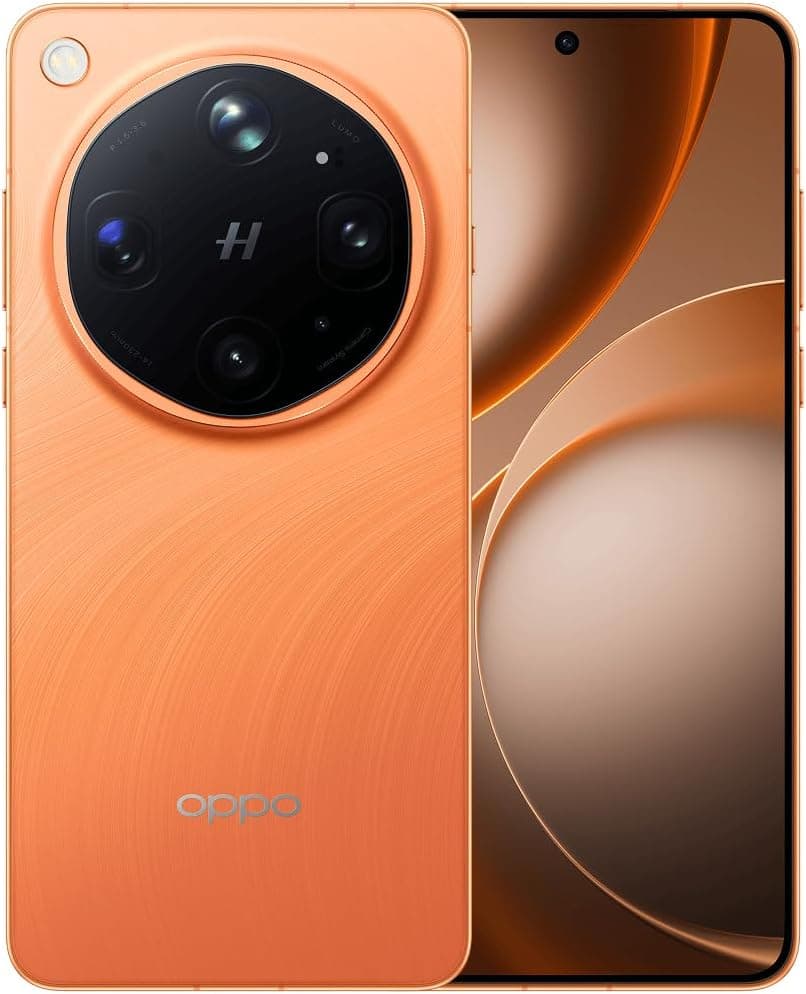
The Find X9 Ultra announces its intentions the moment you lay eyes on it. The camera module is enormous—a long vertical strip that houses four sensors plus a color spectrum sensor, arranged in a layout that deliberately evokes the Hasselblad X2D 100C medium-format camera. The Tundra Umber variant features vegan leather on the back panel, which provides excellent grip and a premium tactile feel, while the Canyon Orange option uses a fiber-reinforced material that's equally grippy but slightly smoother to the touch. Both variants are framed by a metal chassis that feels dense and confidence-inspiring.
At 235 grams, the Find X9 Ultra is heavy by any standard, but the weight is distributed well enough that it never feels unmanageable. The 9.1mm thickness (8.7mm on the Canyon Orange) means this phone won't slip easily into slim pockets, and the camera bump adds another few millimeters when the phone is resting on a table. The camera bump is so prominent that the phone rocks noticeably when you tap the top half of the screen while it's lying flat. A case levels this out, but it's worth noting that this is not a phone designed for one-handed use or minimalist carry.
Oppo has gone all-in on durability with the IP66, IP68, and IP69 ratings. The IP69 rating is particularly notable—it means the phone can withstand high-pressure, high-temperature water jets, a certification typically reserved for ruggedized devices. The Find X9 Ultra is the first mainstream flagship I'm aware of to carry this rating, and it gives real peace of mind for outdoor photography sessions where weather and conditions are unpredictable. The ultrasonic under-display fingerprint sensor is fast and reliable, even with slightly wet or oily fingers.
Display
The 6.82-inch LTPO AMOLED panel is one of the best I've seen on any smartphone. The resolution clocks in at 1440 by 3168 pixels, which translates to roughly 510 pixels per inch—sharper than the Galaxy S26 Ultra and on par with the Xiaomi 17 Ultra. The headline feature is the 144Hz refresh rate, up from 120Hz on the Find X8 Ultra. The difference is subtle in day-to-day use—most system animations and app scrolling already looked smooth at 120Hz—but it becomes noticeable in supported games and when scrolling through long web pages or social feeds. The LTPO technology allows the display to dynamically adjust from 1Hz all the way up to 144Hz, so you're not wasting battery when reading static content.
Brightness is the display's standout achievement. Oppo claims a peak brightness of 3,600 nits, which is among the highest in the industry. In practice, this means the display remains perfectly readable under direct sunlight, with no noticeable dimming or reflection washout. HDR content on Netflix and YouTube looks spectacular, with highlights that punch well above what you'd see on most laptops. The 10-bit color depth delivers smooth gradients without banding, and the Dolby Vision and HDR10+ support means you're getting the best possible dynamic range from compatible content.
The 2,160Hz PWM dimming is a welcome addition for users sensitive to screen flicker. I spent several hours reading on the Find X9 Ultra in a dark room without the eye strain I sometimes experience on OLED panels with lower PWM frequencies. Oppo has also included multiple color profiles—Vivid, Natural, Cinematic, and Professional—that let you dial in the exact color temperature and saturation you prefer. The Natural profile is the most accurate out of the box, tracking close to the sRGB and DCI-P3 gamuts with delta-E values well under 2. For content creators, the Professional profile targets DCI-P3 with a D65 white point, making it suitable for color-critical work on the go. The display also supports HDR Vivid, China's domestic HDR standard, alongside Dolby Vision and HDR10+, making it one of the most format-compatible phone displays available.
Camera System
The camera hardware on the Find X9 Ultra is, quite simply, the most ambitious I've seen on a smartphone. The main sensor is a 200-megapixel Sony LYT-901 with a 1/1.12-inch optical format, an f/1.5 aperture, and optical image stabilization. This is the same sensor class used in dedicated compact cameras, and the physical size advantage is immediately apparent in the quality of the images it produces.
The real story, though, is the dual-telephoto setup. Oppo has equipped the Find X9 Ultra with two telephoto lenses: a 200-megapixel periscope module offering 3x optical zoom (70mm equivalent) with an f/2.2 aperture and OIS, and a 50-megapixel periscope module offering 10x optical zoom (230mm equivalent) with an f/3.5 aperture and OIS. This dual-telephoto approach is unusual—most competitors use a single telephoto lens with either a continuous zoom mechanism (like the Xiaomi 17 Ultra) or a single focal length with crop-based zoom (like the Samsung Galaxy S26 Ultra).
The advantage of Oppo's approach is that both telephoto lenses produce native-quality images at their respective focal lengths. The 3x lens, with its massive 200-megapixel sensor, captures extraordinary detail that holds up to heavy cropping. In practice, you can shoot at 3x, crop in to 6x, and still have an image that looks better than most phones' native 5x zoom. The 10x lens takes over for distant subjects—wildlife, architecture details, concert photography—and delivers results that are genuinely competitive with entry-level mirrorless cameras. Compared to the Samsung Galaxy S26 Ultra's 5x optical zoom, the Oppo gives you both more flexibility at mid-range and better quality at the long end. The Samsung's 5x lens is excellent, but it can't match the 3x lens's ability to create natural-looking portrait shots with genuine background separation rather than computational blur. And the Oppo's 10x native optical capture holds detail in a way that even the best crop-zoom implementations simply cannot reproduce.
Video recording capabilities match the photo hardware. The Find X9 Ultra records 8K video at 30 frames per second, 4K video at up to 120fps for slow-motion, and supports 10-bit HDR video capture in Dolby Vision. The footage is stabilized well—the combination of OIS and electronic stabilization produces gimbal-like smoothness in walking shots, though running shots still show some bounce. Audio recording quality is above average for a smartphone, with the multiple microphones providing decent stereo separation and wind noise reduction. For mobile filmmakers, the Find X9 Ultra offers versatility that rivals dedicated camera setups, at least in good lighting conditions.
The ultrawide is a 50-megapixel sensor with a 120-degree field of view, and it's one of the better ultrawides I've tested. The distortion correction is handled well in software, and the lens is fast enough at f/2.0 to produce usable images in moderate low light. The front-facing camera has been upgraded to 50 megapixels with autofocus, making it one of the best selfie cameras on any phone.
Image Quality: The Processing Dilemma
The Find X9 Ultra has a Jekyll-and-Hyde relationship with image processing. In default Auto mode, the phone applies heavy-handed sharpening, aggressive noise reduction, and saturation boosting that can make images look artificial. Shadows are lifted too aggressively, reducing contrast and drama in scenes that should have punch. Skin tones can take on a cool, clinical cast that flattens portraits. The default processing essentially does the hardware a disservice—it takes data from what may be the best camera sensors on any phone and renders it into something that looks like a computational approximation of a photo.
The solution is Master Mode, Oppo's manual shooting mode that gives you full control over ISO, shutter speed, white balance, and focus. Shooting in Master Mode with DNG Raw output transforms the Find X9 Ultra into a genuinely capable camera system. The raw files are rich in dynamic range and detail, editing beautifully in Lightroom Mobile or Snapseed. With a few minutes of adjustment per photo, you can produce images that rival what you'd get from a dedicated camera like the Leica Q3 or Sony RX100 series.
This bifurcation means the Find X9 Ultra is not a phone for casual point-and-shoot photographers. If you want to pull your phone out of your pocket, tap the shutter, and get a share-ready image, the Xiaomi 17 Ultra or even the Galaxy S26 Ultra will serve you better. But if you're willing to spend time editing your photos and treating mobile photography as a craft rather than a convenience, the raw material the Find X9 Ultra provides is unmatched.
Zoom Performance
The zoom capabilities are the Find X9 Ultra's killer feature. The 3x optical lens is exceptional, producing images with natural perspective compression and subject separation that you simply cannot get from a wide-angle lens. The 200-megapixel sensor captures enough detail that you can crop a 3x image to a 6x equivalent and still have a photo that looks native. The 10x optical lens handles the long end, and it's genuinely sharp—not "smartphone sharp" with aggressive processing, but actually sharp with real detail resolution.
Oppo also offers an optional telephoto zoom attachment lens that clips onto the phone via a dedicated case. This accessory, priced at around $674 (£499), extends the zoom range to a staggering 60x (1,380mm equivalent). The lens is large and heavy, and it's genuinely difficult to use—hand shake is magnified enormously at these focal lengths, and framing moving subjects requires patience and a steady surface. But the results are unlike anything else available on a smartphone. I captured detail of a boat hull from over a mile away that was sharp enough to read the registration numbers. This is a niche accessory for a niche audience, but if you need extreme reach and don't want to carry a full camera kit, it's the only option in the phone world.
Performance and Software
The Snapdragon 8 Elite Gen 5 is Qualcomm's latest flagship chipset, built on a 3-nanometer process, and it delivers exactly the level of performance you'd expect from a 2026 flagship. Everyday tasks are instant, games run at maximum settings without thermal throttling, and the 144Hz display makes everything feel responsive. The Adreno 840 GPU handles even demanding titles like Genshin Impact and Warzone Mobile at high frame rates without breaking a sweat. The phone does warm up under sustained gaming load—the camera bump area in particular gets noticeably warm—but it never became uncomfortably hot or throttled performance in my testing.
The Find X9 Ultra ships with Android 16 and Oppo's ColorOS 16 on top. ColorOS has matured significantly over the past few generations, and the current version is one of the lighter, more restrained Android skins available. It preserves most of Google's Material You design language while adding useful features like smart sidebar shortcuts, game mode optimizations, and flexible always-on display options. The animations are smooth, the notification shade is clean, and there's no noticeable lag or stutter anywhere in the interface.
The downside is bloatware. The Find X9 Ultra ships with a heavy pre-installed app load: Amazon, AliExpress, Temu, Netflix, LinkedIn, plus a full suite of Oppo's own apps for browser, email, notes, file management, and more. You can uninstall most of these, but it's a frustrating first experience on a phone that costs over $2,000. It cheapens the unboxing experience and feels increasingly out of step with the clean software approach of Google's Pixel line or Apple's iOS.
Oppo's update policy promises five major Android OS updates and six years of security patches, which matches Samsung's commitment and beats most Chinese OEMs. The Find X9 Ultra should receive updates through Android 21 and security patches until 2032, which is a reasonable lifespan for a device at this price point.
Battery and Charging
The 7,050mAh battery is the largest I've seen in any mainstream flagship smartphone, and it delivers accordingly. In my testing, the Find X9 Ultra averaged two full days of moderate use with no trouble—that's 6 to 8 hours of screen-on time over a 48-hour period, with mixed usage including photography, navigation, streaming, social media, and email. On heavy days with extensive camera use and gaming, I still ended the day with 35 to 40 percent battery remaining. This is the best battery life I've experienced on any 2026 flagship, period.
Charging is equally impressive. The 100W SuperVOOC wired charging takes the battery from empty to 97 percent in about 30 minutes with the compatible 100W charger. The 50W wireless charging is among the fastest available, though it requires Oppo's proprietary wireless charger to achieve those speeds—standard Qi chargers top out at 15W. The 10W reverse wireless charging is useful for topping up earbuds or a smartwatch.
One frustration: the European retail unit does not include a charger in the box, and Oppo's 100W SuperVOOC charger is not the same as standard USB-C PD chargers. If you buy the Find X9 Ultra, you'll need to purchase a compatible charger separately if you don't already own one. Other markets may include the charger, but it's worth checking before you buy.
Alternatives and Verdict
The Find X9 Ultra operates in a small, exclusive segment alongside the Xiaomi 17 Ultra, the vivo X300 Ultra, and the Samsung Galaxy S26 Ultra. The Xiaomi 17 Ultra offers a more refined point-and-shoot experience with better image processing, a continuous variable optical zoom, and a higher-quality camera grip accessory. The vivo X300 Ultra matches Oppo's camera hardware ambition with its own dual-telephoto approach and a more polished software experience. The Galaxy S26 Ultra is the safe choice—it's available in the US, has the best software update policy, and includes the S Pen, but its camera hardware doesn't match the Oppo's raw specs. For a more budget-friendly alternative, read our Nothing Phone 4a Pro review.
The Find X9 Ultra's position in this field is defined by its extremes: the best battery life, the most versatile zoom range (especially with the optional lens), and the most capable raw camera hardware, but also the most demanding workflow. If you're willing to shoot in manual mode and edit your photos, the Find X9 Ultra can produce images that no other phone can match. If you want a phone that takes great photos automatically and doesn't demand anything from you, one of its competitors will serve you better.
The lack of official US availability is a significant barrier. The Find X9 Ultra is not sold through US carriers, and Oppo has announced it's pulling back from Western markets including Europe and the UK. Importing from third-party sellers on Amazon adds cost and removes warranty support. This alone will disqualify the Find X9 Ultra for many potential buyers, which is a shame because the hardware deserves a wider audience. If you do decide to import, factor in potential customs fees, the lack of carrier-based warranty service, and the risk that certain network bands may not be fully compatible with your carrier. The international version I tested worked reliably on T-Mobile and AT&T networks in the US, but I cannot guarantee compatibility with every carrier in every region.
Who Should Buy the Oppo Find X9 Ultra?
The Find X9 Ultra is for the photography enthusiast who wants the best possible camera hardware in a phone form factor and is willing to work for the results. It's for someone who already shoots in Raw mode, who edits photos in Lightroom, who understands composition and lighting and doesn't want the phone to make creative decisions for them. It's for travelers who want one device for photography, navigation, communication, and entertainment, and who need battery life that can survive a full day of shooting without hunting for an outlet. It's for anyone who has looked at the computational, AI-heavy approach to mobile photography that dominates the market and wished for a phone that prioritized sensor hardware and optical quality over software trickery.
It is not for the casual photographer who wants ready-to-share JPEGs straight out of the camera. It is not for anyone who values a clean software experience over camera hardware. It is not for US-based buyers who want carrier support and warranty peace of mind. And it is not for budget-conscious shoppers—the Find X9 Ultra is a luxury product with a luxury price tag, and the optional lens accessory adds another $674 to the total cost.
Final Thoughts
The Oppo Find X9 Ultra is a statement. It says that Oppo believes hardware still matters in mobile photography, that there is an audience willing to pay a premium for the best possible camera sensors and lenses, and that the computational photography race has left some photographers wanting more. The phone delivers on that promise with hardware that is genuinely ahead of the competition: a 200-megapixel main sensor, a dual-telephoto system that covers 3x and 10x optical zoom with outstanding quality, a display that sets new brightness records, and a battery that outlasts every other flagship on the market.
The compromises are real and significant. The image processing in Auto mode is actively worse than the competition. The software experience is marred by bloatware. The price is extreme. The regional availability is limited. But for the specific audience this phone targets—photography enthusiasts who shoot in manual mode, value raw image quality, and want the most versatile camera system available in a phone—the Find X9 Ultra is the best option on the market. It's a specialist tool that happens to make phone calls, and it's all the better for its refusal to compromise on its core mission.
Pros
- Phenomenal camera hardware with 200MP main sensor and dual telephoto lenses offering 3x and 10x native optical zoom
- Massive 7,050mAh battery delivers two full days of moderate use with industry-leading endurance
- Gorgeous 6.82-inch 144Hz LTPO AMOLED display with class-leading 3,600 nits peak brightness
- Blazing-fast Snapdragon 8 Elite Gen 5 performance with 100W wired and 50W wireless charging
- IP69 dust and water resistance rating exceeds every other flagship smartphone
Cons
- Heavy-handed image processing in Auto mode requires manual shooting in Master Mode for best results
- Not officially sold in the United States, limiting warranty and carrier support
- Extremely expensive at over $2,000 with charger not included in European retail boxes
- Pre-installed bloatware cheapens the software experience on a premium device
- Camera bump is massive and creates stability issues when using the phone on flat surfaces
Final Verdict
The Oppo Find X9 Ultra packs a 200MP main camera, dual telephoto lenses, a 144Hz LTPO AMOLED display, and a massive 7,050mAh battery into one of the most ambitious camera phones ever made, though demanding image processing and regional exclusivity limit its appeal.