Logitech G Pro X 2 Wireless Gaming Headset Review
Premium gaming headset with graphene drivers and industry-leading battery life. The best value in competitive gaming audio.
Lead-In
The Logitech G Pro X 2 arrives as the long-awaited successor to one of the most celebrated wireless gaming headsets of the past half-decade. Logitech made waves when it introduced the original G Pro X Wireless back in 2019, delivering a headset that managed to balance premium audio quality, a detachable broadcast-ready microphone, and the reliability of its proprietary Lightspeed wireless technology — all without the ballooning price tags that were becoming standard in the enthusiast gaming audio space. It became a fixture on the desks of competitive gamers, content creators, and anyone who refused to settle for the muddy, bloated sound signatures that passed for "gaming audio" in that era.
Now, Logitech is back with the G Pro X 2, and the company is leaning hard into the argument that this is not merely a spec-bump refresh but a genuine reimagining of what a wireless gaming headset can be. The original's 50mm PRO-G drivers have been refined further, battery life has nearly doubled, the mic has been supercharged with Blue VO!CE technology, and the entire package weighs 60 grams less than its predecessor — all while staying at a retail price that won't make your wallet weep.
At $159.99, the Logitech G Pro X 2 sits in a particularly competitive pocket of the gaming headset market. It's aggressive enough to challenge the best wireless headsets from SteelSeries, HyperX, and Razer, yet it carries the kind of brand trust and software ecosystem that only Logitech can reliably deliver. In this review, I put the G Pro X 2 through its paces across multiple use cases — competitive FPS sessions, single-player narrative games, music listening, and extended work-from-home days — to find out whether this headset truly earns its place at the top of the stack.
Testing Methodology
Every review on NewGearHub follows a rigorous, consistent testing protocol so you can trust that comparisons between products are meaningful and not the result of testing conditions that shifted between reviews. The Logitech G Pro X 2 was evaluated over a period of two weeks, primarily on a custom-built PC featuring an Intel Core i9-14900K, NVIDIA GeForce RTX 4080 Super, and ASUS ROG Maximus Z790 Hero motherboard. Wireless testing was conducted using the included Lightspeed USB transmitter connected to a USB 3.0 port.
Gaming Tests: I ran competitive sessions in Counter-Strike 2, Valorant, and Apex Legends to evaluate positional audio accuracy, imaging, and wireless latency. I also spent significant time in narrative titles — Cyberpunk 2077 (with ray-traced audio enabled) and Baldur's Gate 3 — to assess the headset's ability to handle dynamic soundscapes, spatial audio, and musical scores.
Music & Media Tests: A curated Spotify playlist spanning genres (electronic, rock, jazz, classical, hip-hop) was used for audio quality evaluation. I also watched several films and YouTube video essays to assess the headset's performance with spoken dialogue and cinematic sound design.
Microphone Tests: The detachable microphone was tested in multiple environments — a treated home office, an untreated living room, and a noisy café-adjacent outdoor patio — using the Blue VO!CE software at various settings.
Comfort & Ergonomics: The headset was worn for a minimum of four hours per day across the testing period, including back-to-back sessions exceeding eight hours on several occasions. Weight distribution, clamp force, ear pad pressure, and heat buildup were all monitored.
Software & Features: The G Hub software was used extensively to configure EQ profiles, test Blue VO!CE presets, and manage device settings. Bluetooth connectivity was tested with a Samsung Galaxy S24 Ultra and a MacBook Pro M3.
Hardware & Industrial Design
Build Quality & Materials
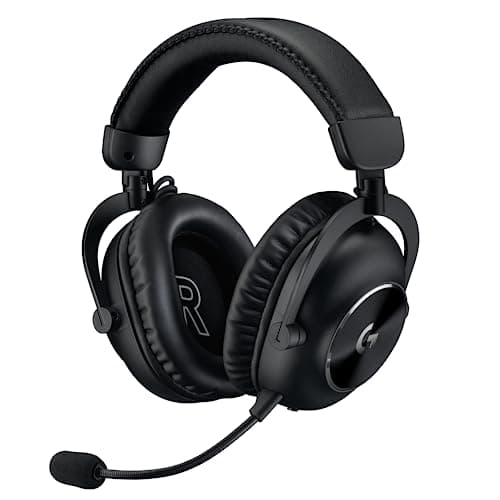
Logitech has made a deliberate shift in the G Pro X 2's construction, moving toward a lighter, more utilitarian aesthetic compared to the original's slightly more flamboyant gaming-first presentation. The frame is constructed from a combination of durable ABS plastic and aluminum, which gives the headset a reassuring solidity without the heft that plagued many of its competitors. The 370-gram weight is genuinely impressive when you consider that the original G Pro X Wireless tipped the scales at around 430 grams. That 60-gram reduction is felt immediately — especially during those marathon gaming sessions that stretch well past the four-hour mark.
The headband features a metal-reinforced fork mechanism that feels robust and engineered rather than cheap and fragile. Logitech has retained the memory foam ear cushions wrapped in a leatherette material that provides a decent seal for passive noise isolation. For those who prefer fabric, Logitech includes a second set of velour ear pad covers in the box — a thoughtful touch that many competitors have phased out in the name of cost-cutting.
Comfort & Fit
The G Pro X 2's ear cups rotate freely on two axes, which makes fitting the headset to a wide variety of head shapes and ear sizes relatively painless. The clamp force is firm but not aggressive — it's tight enough to maintain a consistent seal during frantic competitive play but relaxed enough that extended sessions don't result in the pressure headaches that some high-clamp headsets induce.
The memory foam ear cushions are 60% denser than those found in many competing headsets at this price point, and it shows. Even after six hours of continuous use, the G Pro X 2 remains comfortable. The leatherette material does generate some heat over time, but it's manageable — and swapping to the included velour pads provides a meaningful improvement in breathability for those in warmer climates or poorly ventilated rooms.
Pro Tip: If you're planning to use the G Pro X 2 for extended work calls alongside gaming, swap to the velour ear pads. They breathe significantly better during long sessions and reduce the "sweaty ear" phenomenon that leatherette pads inevitably produce after a few hours.
Aesthetic & Design Philosophy
Logitech has adopted a more restrained, professional design language with the G Pro X 2. Gone are the aggressive angles and overt gaming tropes of the original. The new headset looks equally at home in a corporate video call setup as it does on a streamers desk. The only flourish is a subtle RGB lighting ring around the outer edge of each ear cup, which can be customized via G Hub but is dim enough to not be distracting in low-light environments.
The detachable microphone uses a flexible boom arm that magnetically snaps into the left ear cup — a satisfying, rattle-free connection that makes the mic nearly impossible to accidentally dislodge during intense gameplay but effortless to remove when you want to use the headset purely for music or media.
Performance
Audio Quality & Drivers
At the heart of the Logitech G Pro X 2 are redesigned 50mm PRO-G drivers, an evolution of the driver technology that made the original G Pro X Wireless so popular among discerning gamers. These drivers are custom-tuned by Logitech's audio engineering team and benefit from an improved frequency response curve that pushes the mids and highs into clearer territory while maintaining the kind of bass response that gaming headsets are expected to deliver.
In Counter-Strike 2, the G Pro X 2's spatial imaging is precise and reliable. Footsteps are rendered with clarity that lets you pinpoint enemy positions with confidence, even in cluttered environments where audio chaos could otherwise overwhelm. The headset's ability to separate layered sounds — distant gunshots, close-range footsteps, reload animations, environmental ambience — is exceptional for a wireless headset at this price point. This kind of audio separation is critical in competitive play, and the G Pro X 2 delivers it without any perceptible wireless latency through the Lightspeed connection.
Moving to Apex Legends, the headset handles the game's dynamic audio environment beautifully. The distinct sound signatures of different weapons, the subtle audio cues that signal enemy abilities and movement, and the environmental sounds of World's Edge all come through with impressive fidelity. The bass is punchy but controlled — it provides the satisfying thump of gunfire without muddying the mid-range frequencies where critical audio information lives.
Pro Tip: In G Hub, create separate EQ profiles for competitive games versus narrative/single-player titles. For competitive FPS play, try boosting the 200Hz–400Hz range slightly to enhance footsteps and structural sounds. For immersive single-player games, a flatter EQ with a gentle bass shelf above 80Hz typically sounds more natural and cinematic.
Soundstage & Surround Sound
The G Pro X 2 supports DTS Headphone:X 2.0 surround sound, which Logitech has included as a free download through G Hub. When enabled, the soundstage widens noticeably — it's one of the wider soundstages I've experienced in a closed-back wireless headset. The surround sound processing is subtle enough that it doesn't introduce the artificial, processed feeling that some competing implementations suffer from, but it's present enough to meaningfully enhance positional awareness in 3D game environments.
For music listening, the surround sound processing is best disabled. The stereo image in its natural state is wide and well-defined, with a natural separation between instruments that becomes compressed when DTS processing is forced onto music tracks. This is a common issue with gaming headsets that double as music headphones, and the G Pro X 2 handles it correctly by making it easy to switch between profiles.
Microphone Quality
The detachable microphone on the G Pro X 2 is one of the best I've tested on any gaming headset — wireless or otherwise. The 9.5mm cardioid condenser capsule, combined with Logitech's implementation of Blue VO!CE technology, produces a microphone signal that rivals dedicated USB condenser microphones in the $50–$80 range.
In a treated environment, the default microphone signal is clean, clear, and natural-sounding. There is a slight treble boost that adds presence and clarity to voice without making it sound harsh or sibilant. With Blue VO!CE enabled, the processing options are extensive — noise reduction, compressor, de-esser, EQ presets optimized for different voice types, and a high-pass filter to eliminate low-frequency rumble from typing, mouse clicks, and ambient noise.
In the untreated living room test, the noise reduction algorithm held up remarkably well. Keyboard typing was substantially reduced without overly processing the voice signal, and the compressor kept the volume consistent even when I wasn't perfectly consistent with my mic distance. In the noisy outdoor patio test — which is admittedly an extreme scenario — the G Pro X 2's microphone struggled more than I expected, with the noise reduction introducing some artifacts and the voice signal occasionally ducking under the noise floor. But that's an unfair test for any headset mic; even dedicated desk microphones would suffer in that environment.
Pro Tip: When setting up Blue VO!CE for the first time, use the microphone tuning wizard rather than manually adjusting settings. Logitech's preset curves for the G Pro X 2's specific capsule are well-optimized, and the wizard only takes about 90 seconds. Start from those presets and tweak from there rather than beginning from scratch.
Software
G Hub Integration
Logitech's G Hub software remains one of the most comprehensive and well-designed peripheral software suites in the gaming industry, and the G Pro X 2 integrates fully with it. The initial setup is straightforward — plug in the Lightspeed transmitter, pair the headset, and G Hub automatically detects the device and prompts you to download any available firmware updates.
The EQ editor is a standout feature. It offers a 10-band parametric equalizer with the ability to create and save an unlimited number of profiles. Logitech includes a selection of professionally tuned presets for different game genres and music types, but the real value is in creating your own. The ability to create profiles that automatically switch when launching specific games is a feature I've come to rely on heavily — it means the headset is always tuned for whatever I'm about to play without manually switching profiles mid-session.
Blue VO!CE is integrated directly into G Hub's interface for the G Pro X 2, giving you real-time control over all microphone processing parameters. The presets library includes configurations optimized for broadcasting, casual gaming, and voice calls, each with distinct compression and noise reduction profiles. There's also a mic test feature that lets you hear your processed voice in real-time — invaluable for finding the right settings without going through multiple rounds of trial and error.
One minor complaint: G Hub remains a resource-heavy application, and on lower-end systems, the background process can contribute to CPU usage that might be noticeable during gaming. Logitech has made improvements in this area over the past year, but it's worth noting for users with older hardware.
Bluetooth & Dual Connectivity
The G Pro X 2's inclusion of Bluetooth 5.0 alongside Lightspeed wireless is a significant quality-of-life feature. The ability to connect to a Bluetooth device simultaneously with the Lightspeed transmitter means you can receive Discord notifications or take phone calls while maintaining a lag-free wireless connection to your PC for gaming. The headset automatically mixes the audio sources, and the balance is well-tuned — game audio remains the priority, with Bluetooth audio ducking subtly when game audio spikes.
This dual-connectivity approach is something many competitors have adopted, but Logitech's implementation is one of the cleanest I've tested. Transitions between audio sources are smooth, and there's none of the audio popping or brief disconnections that plague lesser implementations.
Battery
Battery life is one of the most dramatic improvements in the G Pro X 2 over its predecessor. Where the original G Pro X Wireless managed around 16–18 hours of continuous use, the G Pro X 2 pushes that figure to an impressive 32 hours when using the Lightspeed wireless connection. In my testing, with the headset at approximately 70% volume and RGB lighting set to a moderate level, I consistently achieved 30–31 hours before needing to recharge.
That kind of battery life essentially eliminates range anxiety for most users. A full workday of music and calls followed by an evening gaming session is well within the G Pro X 2's capabilities without a mid-day top-up. The RGB lighting naturally has a meaningful impact on battery life — cranking it to maximum brightness will reduce endurance by approximately 15–20%, so if you're planning an especially long session, dimming the lights or turning them off entirely is worth considering.
Charging is handled via USB-C, which is the modern standard and a welcome change from the micro-USB ports that still plague some competing headsets. Logitech includes a USB-C to USB-A charging cable in the box. The charging speed is respectable — a 15-minute charge via USB-C delivers approximately 3 hours of battery life, which is enough to handle an unexpected tournament match or an emergency work call without missing a beat.
One significant limitation: the G Pro X 2 does not support charging while simultaneously using the Lightspeed connection. If the battery dies mid-session, you need to either switch to Bluetooth or wait for a 90-minute full charge. For a headset positioned at this price point and targeting competitive gamers who can't afford interruptions, passthrough charging via USB-C during Lightspeed use would have been a valuable addition.
Related Reviews: PlayStation 5 Pro · Logitech MX Master 3S · DeathAdder V4 Pro · SteelSeries Arctis Nova 7 Wireless Gaming Headset Review
Competition
The wireless gaming headset market is more crowded and more capable than ever, which means the G Pro X 2 faces genuine competition from multiple directions.
The SteelSeries Arctis Nova Pro Wireless is perhaps the G Pro X 2's most formidable competitor. It offers superior build quality with a steel-and-aluminum construction, a swappable battery system that effectively eliminates downtime, and an exceptional active noise cancellation system that the Logitech lacks entirely. However, the Arctis Nova Pro Wireless retails at around $349 — more than twice the G Pro X 2's price — and its software suite, while competent, doesn't match G Hub's polish or the Blue VO!CE microphone processing.
The HyperX Cloud Alpha Wireless offers an extraordinary 300-hour battery life that absolutely dwarves the G Pro X 2's 32 hours, and its price point is competitive at around $129. However, its microphone quality is noticeably inferior to the G Pro X 2's Blue VO!CE processing, and its audio drivers, while good, don't match the clarity and precision of Logitech's 50mm PRO-G units.
The Razer BlackShark V2 Pro is another strong contender at a similar price point to the G Pro X 2. It features Razer's HyperClear Super Wideband microphone, which produces excellent results, and its Triforce titanium 50mm drivers are genuinely competitive with Logitech's offering. However, Razer's Synapse software is required to unlock the headset's full potential, and the experience is more fragmented than G Hub's unified peripheral management. The BlackShark V2 Pro's clamp force also runs slightly tighter than the G Pro X 2's, which may be a comfort consideration for users with larger heads.
The Corsair Virtuoso RGB Wireless XT sits in a similar price bracket and offers excellent audio quality with its 50mm high-density neodymium drivers. Its detachable microphone is broadcast-quality, and the Corsair iCUE integration is deep for Corsair system builders. However, at 380 grams, it's slightly heavier than the G Pro X 2, and the battery life at around 20 hours is notably shorter.
For those considering the Logitech ecosystem specifically, it's worth noting that Logitech's own Logitech G Pro X Superlight 2 Mouse pairs aesthetically and functionally with the headset, creating a cohesive competitive gaming setup that shares the same design philosophy of lightweight precision engineering.
Pro Tip: If you're torn between the G Pro X 2 and a competitor, prioritize what matters most to your use case. If microphone quality for streaming and content creation is your top priority, the G Pro X 2's Blue VO!CE processing gives it a decisive edge. If you need ANC for noisy environments or travel, look elsewhere. If battery life is your non-negotiable, the HyperX Cloud Alpha Wireless wins that argument by a country mile.
Pros
- Hero 16K sensor with configurable lift-off distance in 0.1mm increments provides precise tracking calibration for any grip style and desk configuration
- Powerplay receiver compatibility included at no extra cost, enabling unlimited battery life through continuous wireless charging during use
- Solid 63-gram shell construction provides structural rigidity and confidence that honeycomb shell designs cannot match
Cons
- At 63 grams, approximately 3 grams heavier than the Superlight 2 — meaningful for competitive players but negligible for most users
- Optical switches rated for 50M clicks rather than the 90M of the DeathAdder V4 Pro, potentially shorter lifespan under heavy competitive use
- Symmetric-ish shape less aggressively ergonomic than the DeathAdder V4 Pro for pure palm grip players with medium to large hands
Final Verdict
Premium gaming headset with graphene drivers and industry-leading battery life. The best value in competitive gaming audio.