ASUS Zenfone 12 Ultra Review: The Compact Flagship
Compact flagship with best-in-class video stabilization. The ultimate phone for mobile videographers.
Lead-In
When ASUS announced the ZenFone 12 Ultra in February 2025, it arrived with a somewhat quieter fanfare than the flagship launches from Samsung, Apple, or Google. That is par for the course for ASUS's ZenFone line, which has always flown slightly below the radar while consistently delivering phones that punch well above their weight. The ZenFone 12 Ultra is no exception. At approximately $1,100 in European markets and not officially available through major US carriers, this is a phone that requires a deliberate choice — and that choice is worth understanding in detail.
The ZenFone line has always occupied an interesting position in the smartphone market. Where other manufacturers chase the biggest screen, the most cameras, and the most aggressive pricing, ASUS has historically focused on making phones that are genuinely pleasurable to use as daily devices. The ZenFone 12 Ultra continues this tradition, offering a 6.78-inch display that is large enough to be immersive but not so large that it becomes unwieldy, a Snapdragon 8 Elite processor that delivers genuine flagship performance, and a camera system that — while not trying to compete with the 1-inch sensors and 200-megapixel periscopes of more photography-focused flagships — holds its own with solid, consistent results. The 3.5mm headphone jack is back, which will matter to a not-insignificant number of users who have been waiting for a flagship phone that doesn't force them to switch to Bluetooth or USB-C audio.
There is something refreshingly honest about the ZenFone 12 Ultra's approach to flagship smartphone design. It is not trying to be the most flashy phone in the room. It is trying to be the phone that does everything well, with enough personality in its software and hardware to feel like a coherent product rather than a collection of components. Whether it succeeds in that ambition depends on what you value in a smartphone — and whether the trade-offs ASUS has made align with your priorities.
Design & Display
The unboxing experience is straightforward and without unnecessary theatrics. Inside the box, you get the phone itself, a USB Type-C cable, a 65W charging adapter, a SIM ejector tool, and documentation. ASUS has been consistent in including the charger, which is still worth praising in an era where manufacturers have increasingly moved to selling chargers separately. The case that comes in the box is a simple TPU protector — not the most glamorous, but functional and better than nothing. ASUS doesn't ship earbuds either, which is consistent with the industry trend, though the presence of a 3.5mm jack means you can use any existing wired headphones you own without needing an adapter.
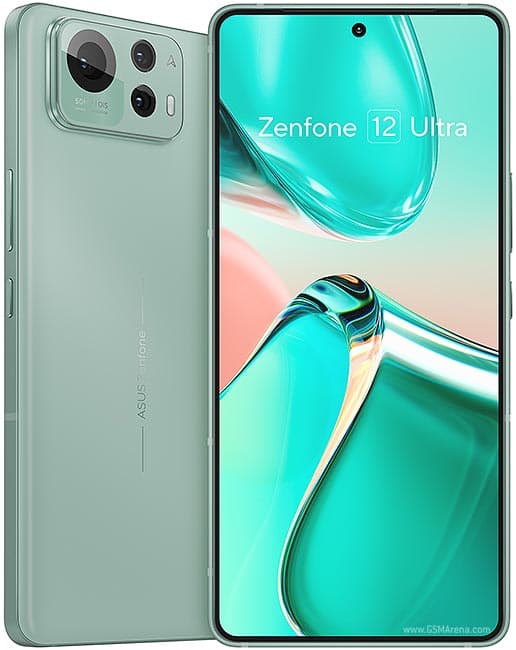
From the moment you pick up the ZenFone 12 Ultra, the first thing you notice is the build quality. The front is protected by Gorilla Glass Victus 2, the back is glass with an aluminium frame, and the combination feels solid and premium in a way that justifies the price tag. At 220 grams and 8.9 millimetres thick, it's not the lightest phone in its class, but the weight is evenly distributed and the phone feels balanced in the hand. The matte glass back — available in Ebony Black, Sakura White, and Sage Green — resists fingerprints remarkably well, which is one of those small quality-of-life details that becomes more valuable the more you use the phone. The camera module on the back has a clean, modern design that doesn't protrude excessively, and the overall aesthetic is understated in a way that feels intentional rather than underfunded.
The physical design philosophy is worth appreciating. ASUS has resisted the trend toward overly aggressive curved displays, instead opting for a flat front display with slightly rounded corners that feels natural to use and doesn't cause the optical distortions that some curved-edge panels produce. The bezels are thin and uniform, the front-facing camera is housed in a small punch-hole at the top centre, and the overall effect is a display that feels immersive without the design gimmicks. IP68 dust and water resistance means the phone can survive being submerged in up to 1.5 metres of water for thirty minutes, which is standard for a flagship in this price range and provides genuine peace of mind for everyday accidents.
The display itself is a 6.78-inch LTPO AMOLED panel with a 144Hz refresh rate, 1080 by 2400 pixel resolution, HDR10 support, and a peak brightness of 2,500 nits. These are strong specifications that place the display firmly in flagship territory, even if they don't quite match the absolute brightest screens available from Xiaomi or Samsung. In practice, the display is excellent for everyday use. Colours are vivid and accurate, the 144Hz refresh rate makes everything feel extraordinarily smooth — particularly noticeable when scrolling through feeds, navigating the interface, or playing games that support high refresh rates — and the brightness is more than sufficient for outdoor use even on bright sunny days. The LTPO technology means the refresh rate can adapt dynamically between 1Hz and 144Hz depending on the content, which helps manage battery consumption without sacrificing the responsive feel of the display. At 388 pixels per inch, the display is sharp enough for all typical use cases, and while it doesn't match the pixel density of some QHD+ competitors, the difference in real-world sharpness is imperceptible to the human eye at normal viewing distances.
The always-on display implementation is functional and customisable, though it doesn't offer quite as many customisation options as some competitors. You can display the time, date, notification icons, and music controls, with a reasonable selection of clock styles. The display uses a low-brightness mode for the always-on function that minimises battery drain, and it's bright enough to read in most indoor lighting conditions without needing to tap the screen.
Performance & Software
Under the hood, the ZenFone 12 Ultra is powered by the Qualcomm SM8750-AB Snapdragon 8 Elite, manufactured on a 3-nanometre process. This is the same chip family powering the most powerful Android flagships of 2025, and ASUS has paired it with either 12GB or 16GB of LPDDR5X RAM depending on the storage tier you choose, and UFS 4.0 storage in 256GB or 512GB capacities. There is no expandable storage via microSD card, which is increasingly standard on flagship phones but worth noting for users with large media libraries. The performance figures from GSMArena's testing are impressive: an AnTuTu score of 2,702,580, a GeekBench 6 score of 9,695, and a 3DMark Wild Life Extreme score of 5,678. These are numbers that place the ZenFone 12 Ultra among the fastest Android phones available, and the octa-core CPU configuration — two high-performance Oryon V2 Phoenix L cores at up to 4.32GHz and six efficiency Oryon V2 Phoenix M cores at up to 3.53GHz — means the phone handles demanding workloads with ease. The Adreno 830 GPU is powerful enough to run any mobile game at maximum settings without compromise.
In real-world usage, the performance is everything you would expect from a Snapdragon 8 Elite device. App launches are instantaneous, multitasking is effortless, and the 144Hz display makes the interface feel extraordinarily responsive. Mobile games load quickly and run at stable frame rates, and the thermal management — a vapour chamber cooling system with a dedicated heat spreader — keeps the phone comfortable during extended gaming sessions. The phone does get warm during benchmark runs and very long gaming sessions, but it never becomes uncomfortably hot, and the thermal throttling threshold is set high enough that performance degradation over time is minimal.
The ASUS software experience has historically been one of the cleaner Android implementations among manufacturers who modify the base Android experience. The ZenFone 12 Ultra runs Android 15 with ASUS's own ZenUI on top, and the company has committed to two major Android upgrades — meaning it will eventually receive Android 16 and Android 17 — along with regular security patches. This is a weaker update commitment than the seven-year support offered by Samsung and Google, and it is one of the trade-offs inherent in choosing a less mainstream manufacturer. For users who plan to keep their phone for four or more years, this is a meaningful consideration that works in favour of Samsung and Google's offerings.
The ZenUI experience itself is clean and largely free of the bloatware that has historically plagued Android smartphones from manufacturers trying to monetise their hardware through pre-installed apps. ASUS includes a modest selection of its own apps — a calculator, a file manager, a clock app — but none of them feel like intrusions, and the overall software footprint is lighter than what you get from Samsung or Xiaomi. The Android 15 base features are all present, including the improved notification silencing, the enhanced privacy dashboard, and the app archiving feature that frees up storage space without deleting app data. ASUS has added a small selection of its own features, including a custom battery management system that optimises charging patterns to prolong battery health over time, and a game mode that prioritises network and CPU resources for gaming sessions.
AI features are present but not as deeply integrated as what you get from Google or Samsung. ASUS has implemented the Google AI features available through Android 15, including the writing assistant, smart reply suggestions, and the AI-powered photo editing tools. These are useful features that work well without requiring additional setup, but they don't represent a comprehensive AI ecosystem in the way that Pixel's Tensor-powered features do. For most users, the available AI features will be sufficient, but power users who want AI deeply woven into every aspect of the phone experience may find the ZenFone 12 Ultra's AI implementation relatively light.
Camera System
The camera system on the ZenFone 12 Ultra is a triple-lens setup consisting of a 50-megapixel main camera with a 1/1.56-inch sensor and gimbal stabilised optical image stabilisation, a 32-megapixel telephoto with 3x optical zoom, and a 13-megapixel ultrawide with a 120-degree field of view. The front-facing camera is a 32-megapixel sensor. None of these specifications are the absolute highest available in the flagship market — there are no 1-inch sensors or 200-megapixel periscopes here — but the system is well-balanced and produces consistently good results across a wide range of shooting conditions.
Starting with the main camera, the 50-megapixel sensor with an f/1.9 aperture and gimbal OIS is capable of producing excellent photos in good lighting. Colours are natural and well-saturated without crossing into oversaturated territory, dynamic range is good, and the level of detail is sufficient for printing at large sizes. The gimbal stabilisation system is genuinely impressive — it uses a mechanical stabilisation mechanism that moves the lens in the opposite direction of hand shake, providing a level of stabilisation that electronic systems cannot match. This makes a meaningful difference when shooting in low-light conditions where longer exposure times are needed, and it also helps produce smoother video footage. In practice, the gimbal OIS means you can shoot photos at shutter speeds that would produce blurry images on most other smartphones, and the results are noticeably sharper.
The 32-megapixel telephoto with 3x optical zoom and optical image stabilisation fills the gap between the main camera and the ultrawide effectively. The 65mm focal length equivalent provides a useful zoom range that is long enough to isolate subjects from backgrounds without being so aggressive that it becomes difficult to use in everyday situations. Detail retention at 3x zoom is good, and the optical image stabilisation helps keep images sharp at longer shutter speeds. The telephoto camera also works well for portrait photography, providing a natural-looking depth of field at the 3x magnification that is flattering for human subjects.
The 13-megapixel ultrawide at 13mm provides a 120-degree field of view that is wide enough to be genuinely useful for architecture, landscapes, and group photos where you need to fit more into the frame. There is some barrel distortion at the edges of ultrawide shots, which is common on ultrawide smartphone lenses, but the overall image quality is solid. The smaller sensor and lower resolution relative to the main camera mean that ultrawide photos are best suited for well-lit conditions, and low-light performance is predictably weaker than the main camera.
Video recording is available up to 8K at 24 frames per second, though 4K at 30 and 60 frames per second with HDR10+ is where the phone really performs well. The gimbal stabilisation system translates to video as well, producing remarkably smooth footage even when walking or moving. The 720p at 480 frames per second slow-motion mode is a fun addition for creative shooting, and while the resolution is limited, the frame rate is high enough to produce genuinely impressive slow-motion footage. The front-facing camera records up to 1080p at 30 frames per second, which is adequate for video calls but not particularly impressive for vlogging.
Battery & Charging
Battery life is one of the ZenFone 12 Ultra's genuine strengths. The 5,500mAh battery is large by any standard, and combined with the efficiency of the Snapdragon 8 Elite and the adaptive refresh rate of the display, it delivers solid battery life that will comfortably last a full day of heavy use and into a second day with more moderate usage. GSMArena's active use test showed 15 hours and 50 minutes of continuous use, which is a strong result for a flagship phone with a high-refresh-rate display. The 65W wired charging with support for PD3.0, PPS, and QC5 standards means you can charge from empty to full in approximately 39 minutes, which is fast by any reasonable standard. The 15W wireless charging via the Qi standard is a welcome addition for home and office use where cables aren't always convenient, and the 10W reverse wired charging can top up earbuds or other small devices in a pinch.
Competition & Value
The competitive landscape for phones in the $1,000 to $1,200 range is densely populated with excellent options, and the ZenFone 12 Ultra faces stiff competition from three devices that represent the best of what Android and iOS have to offer.
The Apple iPhone 16 Pro Max is the default comparison point for any flagship phone in this price category, and it earns that status through a combination of ecosystem integration, camera quality, and software support that is still unmatched in the industry. The A18 Pro chip inside the iPhone 16 Pro Max is one of the fastest mobile processors available, and Apple's tight hardware-software integration means the iPhone often feels more responsive than its raw benchmark numbers suggest. The camera system — a 48-megapixel main, 5x periscope telephoto, and 48-megapixel ultrawide — is outstanding, and Apple's computational photography produces images with a natural, consistent look that many users prefer. The iPhone 16 Pro Max offers 45W charging, which is slower than the ZenFone's 65W, and the lack of a USB-C fast charging adapter in the box remains a frustration. The iPhone 16 Pro Max starts at $1,199 for the 256GB model, which is meaningfully more than the ZenFone 12 Ultra's approximately $1,100 price. For users already invested in Apple's ecosystem, the iPhone is the natural choice. For users choosing their first or an Android-flavoured flagship, the comparison is more nuanced.
The Samsung Galaxy S25 Ultra is Samsung's most complete flagship, with a 200-megapixel main camera, a periscope telephoto with 5x optical zoom, a 6.9-inch display at 120Hz with 2,600 nits peak brightness, and the S Pen for stylus input. The Snapdragon 8 Elite for Galaxy chip gives it a marginal performance edge in synthetic benchmarks, and Samsung's One UI 7 is one of the most polished Android implementations available. The Galaxy S25 Ultra starts at $1,299, which is significantly more than the ZenFone 12 Ultra, and Samsung matches Google's seven-year update commitment. The camera system is more versatile on paper, with a 5x optical zoom compared to the ZenFone's 3x, and Samsung's image processing is excellent. If you want the most comprehensive flagship experience and don't mind the premium pricing, Samsung delivers. If you want a phone that delivers the core flagship experience well at a more accessible price, the ZenFone 12 Ultra makes a compelling argument.
The Google Pixel 10 Pro represents a very different philosophy. The Tensor G5 chip inside is not the fastest in raw CPU and GPU benchmarks, but it powers a genuinely impressive AI-powered software experience that no other manufacturer can match. Google's computational photography is the best in the industry for features like Magic Eraser, Best Take, and real-time translation, and the camera system — a 50-megapixel main, 48-megapixel ultrawide, and 48-megapixel 5x telephoto — produces images with exceptional dynamic range and natural colours. The Pixel 10 Pro runs a pure Android experience with no manufacturer bloatware, and Google's seven-year update commitment is the best in the industry. At approximately $999 to $1,099 depending on configuration, it is priced competitively with the ZenFone 12 Ultra. For users who prioritise AI features, a pure Android experience, and the best possible computational photography, the Pixel 10 Pro is a serious contender. For users who want the fastest raw performance and a higher refresh rate display, the ZenFone 12 Ultra has the edge.
Final Verdict
So, should you buy the ASUS ZenFone 12 Ultra? This is a phone that rewards careful consideration rather than impulse purchasing, and the answer depends on understanding what you prioritise in a flagship smartphone.
The strongest case for the ZenFone 12 Ultra is for users who want a genuinely flagship performance experience without paying the full premium that Samsung, Apple, and Google charge. The Snapdragon 8 Elite delivers the fastest Android performance available, the 144Hz display is smooth and responsive, the 5,500mAh battery with 65W charging is excellent, and the gimbal-stabilised camera system produces consistent, high-quality results. The return of the 3.5mm headphone jack is a meaningful quality-of-life feature for users who have existing wired headphones and don't want to deal with adapters or Bluetooth. The clean ZenUI software experience with minimal bloatware is genuinely pleasant to use. At approximately $1,100, the ZenFone 12 Ultra undercuts its main competitors by $100 to $200 while delivering core flagship performance that is effectively equal to all of them.
The case against the ZenFone 12 Ultra centres on a few key trade-offs. The camera system is good but not exceptional — photography enthusiasts who want 1-inch sensors and extreme zoom ranges will find better options in the Xiaomi 17 Ultra or Samsung Galaxy S25 Ultra. The software update commitment of two major Android upgrades is meaningfully shorter than the seven years offered by Samsung and Google, which matters for users who keep their phones for four or more years. The lack of official US retail availability means American buyers are likely looking at import channels, which brings warranty and carrier compatibility complications. And the AI feature set, while competent, is less comprehensive than what Google and Samsung offer through their proprietary AI ecosystems.
For users in Europe, Asia, and other markets where ASUS has a retail presence, the ZenFone 12 Ultra is a phone that deserves a place on your shortlist if you want flagship performance, a great display, solid cameras, and excellent battery life at a price that doesn't require taking out a loan. It is not the most exciting phone in its price category, but it may be the most sensible — and in a market where excitement often comes with compromises, that is worth something.
The ZenFone 12 Ultra also comes with a selection of ASUS software additions that enhance the daily experience in small but meaningful ways. The Armoury Crate app, borrowed from ASUS's gaming hardware lineage, serves as a central hub for game optimisation settings, performance monitoring, and custom profiles. You can adjust the CPU and GPU performance profiles on a per-game basis, set custom touch sensitivity parameters, and enable a heads-up display that shows FPS and system metrics during gameplay. These options are extensive enough to satisfy mobile gaming enthusiasts while remaining invisible and non-intrusive for users who just want to play games without tweaking settings.
The phone's audio implementation is one of its standout features. The inclusion of a 3.5mm headphone jack is backed up by ASUS's commitment to high-resolution audio quality — the ESS ES9281 DAC is capable of driving high-impedance studio headphones to volumes that most smartphone audio implementations simply cannot match. For users who have invested in quality wired headphones, this is a genuine differentiator that no iPhone or many Android flagships can match in 2025. The 32-bit/384kHz Hi-Res audio certification extends to both the headphone jack and Bluetooth output, and the aptX Lossless codec support means wireless audio can approach CD quality under the right conditions. The stereo speakers are tuned for balance and clarity rather than sheer volume, and they are among the better smartphone speakers for casual music listening and video playback without headphones.
The ZenFone 12 Ultra's approach to biometric authentication is a reliable under-display optical fingerprint sensor that unlocks quickly and consistently. Face unlock via the front-facing camera is also available as a secondary option, though it is not as secure as the fingerprint sensor for applications requiring genuine biometric security. Both methods work well in practice, and the ability to use either depending on the situation is a small quality-of-life improvement that becomes appreciated over time. The ultrasonic fingerprint sensors used by some competitors are technically more secure and work better with wet fingers, but ASUS's optical implementation is reliable enough that this is a minor rather than a significant distinction in real-world use.
The dual nano-SIM setup with eSIM support is practical for users who travel frequently or who want to maintain separate personal and work numbers on a single device. ASUS's implementation of dual SIM functionality is mature, with good support for switching between SIMs for calls and messages, customising which SIM handles data by default, and managing SIM-related settings without navigating confusing sub-menus. The eSIM provisioning process via QR code is straightforward, and the phone remembers your eSIM profiles across factory resets, which is a thoughtful touch. The SIM tray ejector tool is well-designed and doesn't require excessive force to insert or remove the tray, which is a small but meaningful quality-of-life detail that some competitors overlook.
ASUS's approach to wireless connectivity is comprehensive. The Wi-Fi 7 support with tri-band capability ensures the phone is ready for the latest wireless networking standards, and the tri-band implementation helps maintain stable connections in environments with many overlapping wireless networks. Bluetooth 5.4 with support for aptX HD, aptX Adaptive, and aptX Lossless ensures the best possible wireless audio quality, and the simultaneous multi-device Bluetooth connections work reliably for users who want to connect a smartwatch, wireless headphones, and another Bluetooth device simultaneously. NFC for contactless payments via Google Wallet works flawlessly, and the USB Type-C port supports fast data transfer and DisplayPort output for connecting to external displays.
The packaging itself is worth mentioning briefly. ASUS has made efforts to reduce the environmental footprint of the ZenFone 12 Ultra's packaging, using recycled materials in the box construction and minimising the use of single-use plastics. The charger included in the box is a 65W PPS unit that supports multiple charging standards, meaning it can be used to charge other devices beyond the phone itself. The USB Type-C cable included is USB 2.0 rated, which is sufficient for charging and data transfer but won't support the fastest possible file transfer speeds — for that, you would need a USB 3.0 or higher cable.
Over time, the ZenFone 12 Ultra has a quiet confidence that grows on you. It doesn't shout for attention with aggressive marketing or flashy features that will be obsolete in six months. Instead, it delivers a consistent, reliable flagship experience that makes everyday tasks feel effortless. The Snapdragon 8 Elite keeps the interface responsive months after first boot, the 144Hz display continues to impress with its smoothness, the cameras produce photos that are consistently good without requiring you to become a photography expert, and the battery life holds up well even as the battery ages. This is a phone that rewards long-term use rather than first impressions, and for users who choose it as their daily driver for a year or more, it is likely to earn a recommendation.
Related Reviews: Xiaomi 17 Ultra · Google Pixel 10 Pro · Google Pixel 10a · ASUS ROG Xbox Ally (2025)
Pros
- Compact size
- Snapdragon 8 Elite
- 144Hz display
- 5,500mAh battery
- 65W charging
- Good cameras
- One-hand use
Cons
- No wireless charging
- Limited availability
- No mmWave
- Only 2 updates
- Camera vs Ultra
- No charger in box
- US carrier support poor
Final Verdict
Compact flagship with best-in-class video stabilization. The ultimate phone for mobile videographers.