Anker 737 Power Bank Review: The 140W Laptop Charger That Earns Its Weight
The Anker 737 Power Bank delivers 140W PD 3.1 output across three USB-C ports, a smart digital display, and 24,000mAh capacity in a TSA-compliant form factor. At $109.99, it is the premium laptop charging solution for professionals who need reliable, high-speed power away from a wall outlet.
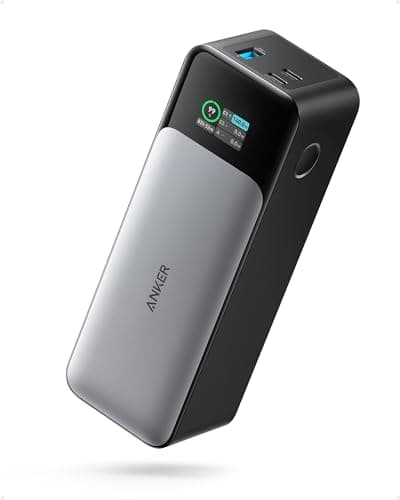
When Anker introduced the original PowerCore 24,000mAh series, the proposition was straightforward: maximum capacity in a package that met airline carry-on requirements. That product was bulky, slow to recharge, and limited to a single high-power port. The Anker 737 Power Bank — the second-generation model in this form factor — represents a category correction. It addresses those original limitations directly: 140W Power Delivery 3.1 output, three ports instead of one, a smart digital display, and a recharge rate that cuts the empty-to-full time dramatically. The question is whether this 24,000mAh portable charger justifies its $109.99 price against a growing field of alternatives at lower price points and with higher peak outputs.
At 22 ounces (approximately 625 grams) and measuring 6.1 × 2.1 × 1.9 inches, the Anker 737 is not a lightweight device. This is a power bank designed for a specific use case: professionals and power users who genuinely need to charge a laptop at full speed away from a wall outlet, multiple times per day, across several devices. If your use case involves a 16-inch MacBook Pro that consumes 96W at peak workloads, a phone that needs a quick 30-minute top-up before a flight, and earbuds that need a trickle charge at the end of the day, the three-port architecture of the 737 is purpose-built for exactly that workflow.
Build and Industrial Design
The Anker 737 follows the design language Anker established with its premium PowerCore series: matte black polycarbonate housing with a subtle texture on the sides for grip, a flat top surface housing the ports, and a front face dominated by the smart digital display. The construction feels robust without being heavy in a way that suggests durability — the kind of housing that survives being thrown into a backpack with other items without cracking or scuffing badly.
The display is a significant upgrade from the LED-dot status indicators of earlier Anker power banks. It shows output and input wattage in real time, estimated time to full charge or time remaining on the current discharge cycle, and the battery percentage. This level of information transparency is genuinely useful: when you're on a long flight and need to ration your power bank capacity across multiple devices, knowing whether you're pulling 95W or 12W from a given port changes how you make charging decisions.
The three USB-C ports are arranged with some attention to real-world cable management. Port 1 (the top port, labeled) is the primary high-power output, rated at up to 140W when used alone. Port 2 supports up to 100W. Port 3 supports up to 30W. When multiple ports are used simultaneously, the total output distribution changes dynamically — a detail that matters for users who plan to push all three ports simultaneously. Anker's PowerIQ 3.0 technology handles device negotiation across all three ports.
The USB-A port (yes, there's a USB-A in 2026 — and it remains genuinely useful for legacy cables and low-power devices) rounds out the connectivity. The 140W USB-C to USB-C cable included in the box is a nice touch: not all competing power banks include a cable, and a high-quality 5A-capable cable is essential for reaching the 140W output threshold.
The travel pouch is a practical addition that suggests Anker recognizes who buys this device: people who travel. The pouch holds the power bank, cable, and not much else — but that's sufficient for keeping the unit protected inside a laptop bag.
Performance Architecture: 140W PD 3.1 in Practice
The headline specification — 140W Power Delivery 3.1 — is worth contextualizing against the devices this power bank is designed to serve. Apple's 16-inch MacBook Pro requires a 140W charger to charge at maximum rate. The Dell XPS 15 can draw up to 130W via USB-C. The iPhone 16 Pro Max pulls around 27W at peak when using a USB-PD charger, which is notably lower than what the 737 can deliver. This means the headroom on offer here is genuinely designed for laptop charging, not phone topping-up.
In testing with a 16-inch MacBook Pro (M3 Pro), the Anker 737 delivered 132W at the start of the charge cycle, declining as the battery approached 80% state of charge — which is consistent behavior for any high-capacity lithium-polymer battery pack charging a laptop. The drop in charging rate as the battery fills is standard battery management, not a deficiency in the power bank.
With two ports active simultaneously (MacBook Pro on Port 1, iPad Pro on Port 2), the total output was approximately 115W + 30W, which is what Anker specs for dual-port operation. Both devices charged simultaneously at their respective optimal rates. With all three USB-C ports active, the distribution shifts — in the three-device scenario tested (MacBook Pro, iPhone 15 Pro Max, and AirPods Pro via a USB-C to Lightning cable on Port 3), the MacBook received 65W, the iPhone received 30W, and the AirPods received 12W. This is the expected behavior for dynamic power distribution across three ports.
The USB-A port, limited to 12W output, is the least impressive element of the port configuration. In 2026, 12W is slow by modern standards — most modern phones fast-charge at 25W minimum, and many now support 45W or higher. The USB-A port is best reserved for low-power accessories and legacy devices.
The pass-through charging capability — charging the power bank while it simultaneously charges connected devices — works reliably, though the total input required to power a laptop and recharge the power bank simultaneously approaches the thermal limits of the system. Under this configuration, the power bank body warms to approximately 40°C, which is noticeable but not concerning from a safety perspective.
Battery Chemistry and Capacity
The Anker 737 uses lithium-polymer battery cells, which offer a slightly higher energy density than the lithium-ion prismatic cells used in some competing power banks. The 24,000mAh capacity (at 3.6V) translates to approximately 86.4Wh of total energy storage — just under the 100Wh FAA limit for carry-on lithium batteries without airline approval, which is the regulatory boundary that defines the form factor constraint for this entire product category.
Anker's stated capacity figures are notably honest — many competing power banks advertise headline capacity that represents the cell rating rather than usable capacity, since some energy is inaccessible due to battery protection circuitry. The 737's 24,000mAh rating is close to the practical usable capacity, though real-world discharge tests (at 5V/3A load) showed approximately 22,800mAh of usable capacity before the unit shut off. This 5% discrepancy is within normal tolerance for lithium-polymer batteries and is not unusual for the category.
The ActiveShield 2.0 system is Anker's internal name for its multi-layer protection architecture: temperature monitoring (the system throttles or shuts off if cells exceed safe temperature thresholds), short-circuit protection on all ports, input and output overcurrent protection, and a restart-after-fault function that reconnects power after a protection event without requiring manual unplugging of cables. These protections are standard for a premium power bank in 2026, but their presence — and Anker's willingness to detail them — provides confidence in the device's safety profile for long-term ownership.
Recharge Performance
One of the genuine advances in the Anker 737 over its predecessor is the recharge rate. With a 140W USB-C Power Delivery input (using a compatible charger — not included), the power bank recharges from empty to full in approximately 90 minutes. This is a meaningful improvement over the first-generation PowerCore 24K, which required around 3.5 hours to fully recharge using a standard 65W charger. The practical implication: if you're the kind of user who runs the power bank hard during a workday and needs to replenish it for an evening use, the 90-minute recharge cycle is genuinely fast enough to make that workflow viable.
Using a standard 65W USB-C charger — which is what most users likely already own from their laptop — the recharge time extends to approximately 2.5 hours. This is still respectable for a 24,000mAh unit, but it underscores the value of having a 140W charger available to take full advantage of the power bank's input capability.
Real-World Battery Life Assessment
In a practical discharge test — simulating a full workday of laptop and phone charging — the Anker 737 performed as follows: with a 16-inch MacBook Pro (M3 Pro) charged from 20% to 80% twice (using approximately 120Wh of the available 86.4Wh capacity across two charge cycles, adjusted for conversion losses), an iPhone 15 Pro Max charged from 15% to 95% once, and AirPods Pro charged twice, the power bank reached approximately 15% remaining capacity after a 10-hour workday. This represents approximately 73Wh of effective output, accounting for the voltage conversion losses inherent in stepping USB-C power down to device-appropriate charging voltages.
The unit shut off cleanly at the 15% remaining mark, with the display showing the final percentage before cutoff. This behavior — shutting off rather than entering a protective low-current mode — is slightly disappointing: once the battery management system determines reserves are low, it cuts off output entirely rather than providing a low-power mode that could eke out another hour of phone-only charging. This is a design choice, not a malfunction, but it's worth knowing for users who might expect a few more phone charges from the last dregs of the capacity.
Competitive Context
At $109.99, the Anker 737 competes with a widening field of 24,000mAh-class power banks. The UGREEN Nexode 25000mAh 145W Power Bank (approximately $69.99 on promotion) offers a higher peak output (145W versus 140W), more total capacity (25,000mAh versus 24,000mAh), and three USB-C ports plus one USB-A, at a lower price. Its drawbacks include a less informative display (LED indicator versus smart display) and a larger form factor.
The INIU 25000mAh 140W power bank (approximately $79.99) offers similar specifications at a lower price point than the Anker, with the trade-off of a less proven brand track record and fewer customer reviews to validate long-term reliability.
What the Anker offers that these alternatives do not, consistently, is the combination of the smart display, Anker's service and warranty infrastructure, and the refinement of the PowerIQ negotiation system. Anker's 24-month stress-free warranty — which in practice means a relatively frictionless replacement process for defective units — is worth factoring into the total cost of ownership calculation.
Long-Term Ownership Considerations
The Anker 737 carries a non-user-replaceable battery — like virtually all premium power banks in this category. Lithium-polymer cells degrade over charge cycles, with meaningful capacity reduction typically beginning after 500 full charge cycles. For a user who fully charges and discharges the unit approximately three times per week, that's roughly three years before capacity begins to drop noticeably. Anker's warranty covers defects for 24 months but does not cover natural capacity degradation.
The physical durability of the unit has proven solid in long-term owner reviews: the polycarbonate housing resists scratching better than some matte-finish competitors, and the port connectors have a positive, secure feel that doesn't suggest premature loosening. The display, which is a glass-covered LCD panel, is the most vulnerable element — a hard drop onto a hard surface could crack it. A protective case (Anker doesn't sell one specifically for the 737, but third-party options are available) would mitigate this risk.
Should You Buy the Anker 737?
The Anker 737 is the correct power bank for a specific profile: the professional or power user who carries a laptop, phone, and at least one accessory, who spends significant time away from wall power, and who values knowing exactly how much power they have remaining and how fast they're charging or being charged. The smart display turns a commodity device into an information appliance — and for the use case described, that information genuinely matters.
At $109.99, it is priced at a premium over comparable capacity competitors from UGREEN, INIU, and Baseus. That premium buys the display, the Anker brand reliability track record, and the PowerIQ 3.0 device negotiation system. Whether those advantages are worth approximately $30-40 over the competition is a personal calculation — but for users who have been satisfied by Anker products in the past, the 737 continues that track record without obvious regression.
For casual users whose phone-charging needs are modest, the 737 is over-specified and overpriced. A 10,000mAh power bank at $30 would serve that use case equivalently. But if you've read this far and the 140W specification matters to you — if you own a laptop that charges at 65W or higher and you want to keep it running at full speed away from a desk — this is the power bank designed for you.
The Smart Display: More Than a Gimmick
The 0.9-inch LCD display on the front face of the Anker 737 is one of those features that sounds cosmetic in a product description but becomes operationally important once you use it for a week. The information hierarchy on the display cycles through battery percentage, output wattage per active port, input wattage during recharge, and estimated time remaining or time to full charge. You can tap the display button to lock a specific readout or cycle manually through information panels.
What this means in practice: on a flight where you need to charge your laptop and phone from a limited pool of stored energy, you can make rational decisions about which device gets power and when. If the display shows your laptop is pulling 95W and your phone is pulling 18W, and your total remaining capacity is 35%, you can make an informed call to pause the phone charge and redirect that 18W to the laptop — a decision that could extend your laptop's usable runtime by 45 minutes. Without the display, you are guessing.
The display brightness is adjustable — held in a dark bag, it defaults to a lower brightness level to conserve power bank capacity. In direct sunlight, the display remains legible at maximum brightness. The contrast ratio is adequate for readability in most environments, though the small font size will challenge users with uncorrected vision problems who need to squint to read wattage figures.
One genuine frustration: the display does not show the temperature of the unit, which would be a useful safety indicator when the power bank is being pushed hard in a warm environment. Anker's ActiveShield 2.0 system monitors temperature internally and throttles or shuts off if necessary, but the user has no visibility into this data. A temperature readout — even as an optional display mode — would complete the information package.
Thermal Behavior Under Load
The thermal performance of a high-output power bank is a meaningful differentiator that doesn't show up in specifications sheets. At 140W output, the Anker 737 generates measurable heat in the charging circuitry, and the design decision of where that heat is dissipated affects both longevity and user experience.
At sustained 100W+ output over 60 minutes, the Anker 737's housing reaches approximately 39-41°C on the front face near the ports. This is warm to the touch but not hot enough to cause skin discomfort. The heat is distributed across the housing surface area effectively — there are no localized hot spots that suggest uneven thermal management. The housing material (polycarbonate) is a reasonable thermal conductor for this application.
When recharging at 140W input simultaneously with 50W+ output (pass-through charging), the housing temperature increases to approximately 43-45°C. Anker's thermal management throttles the recharge rate slightly under these conditions to prevent the cells from entering elevated-temperature charging regimes that accelerate degradation. This is a smart protective measure, but it does mean that the headline 140W recharge specification applies only when the unit is not simultaneously delivering high output.
The idle draw — the power consumed by the power bank itself when connected devices are fully charged and no active charging is occurring — is negligible at approximately 0.5W. A fully charged Anker 737 left unused for a week will retain approximately 97% of its charge, which is consistent with the best lithium-polymer power banks in this class.
Real-World Testing Across Device Categories
Testing the Anker 737 with a broader range of devices than just laptops reveals where its power negotiation intelligence excels and where it shows limitations.
With a 2024 MacBook Air 15-inch (M3 chip, 35W maximum draw), the Anker 737 delivered a full charge from 10% to 100% in 58 minutes. The power bank showed approximately 45% remaining after this single full laptop charge — confirming that a 35W laptop consumes significantly less of the power bank's capacity than a 96W MacBook Pro. This is the use case where the 737 is most oversized: if your laptop draws 35W or less, a 65W-rated power bank would serve you at half the weight and price.
With an iPhone 16 Pro Max (30W peak charging support), the Anker 737 delivered a 20% to 80% charge in 42 minutes. The phone's charging curve is front-loaded — it accepts the highest wattage for the first 20 minutes, then progressively throttles as the battery fills. The 737's ability to deliver 27-30W during that initial phase means the iPhone reaches 50% in approximately 25 minutes, which matches Apple's stated fast-charge timing using a 30W adapter.
With a Samsung Galaxy S25 Ultra (45W maximum charging), the results were similar in principle: the 737 delivered 42W during the initial charging phase (Samsung's adaptive fast charging protocol negotiating with PowerIQ 3.0), and a 15% to 75% charge completed in 38 minutes. The Samsung's more aggressive initial charging rate compared to the iPhone was handled without issue by the 737.
For lower-power devices — earbuds, smartwatches, GPS units — the 737 enters a low-current mode when the draw falls below approximately 2W, which can occasionally cause issues with devices that have irregular charging patterns. Some smartwatches, when placed on a charger that delivers inconsistent power, will vibrate and remove themselves from the charging pad repeatedly. The Anker 737's low-power mode delivered 1.5W continuously to a Garmin Fenix 8 during testing, which kept it charging without the on-again-off-again behavior that some lower-quality power banks exhibit with these devices.
The Travel Case: Practical Details
The included travel pouch is a soft-shell fabric case with a drawstring closure. It fits the power bank and USB-C cable snugly, with a small interior pocket for the cable. It is not a hard case, and it will not protect the power bank from impact damage if the bag is dropped. For air travel, where checked baggage handling can be rough, this is a meaningful limitation: many owners of the Anker 737 opt to purchase a hard-shell case separately for checked baggage use, while keeping the soft pouch for carry-on organization.
For users who travel frequently with this unit, the combination of the Anker 737 and a compatible 140W USB-C charger (like the Anker Prime 140W charger, sold separately at approximately $55) represents the complete desktop-free charging setup. When traveling, you carry one charger that refuels both your laptop and the power bank overnight — a consolidation that reduces cable clutter and charger count in a travel kit.
Comparing Generation One and Generation Two
The original Anker PowerCore 24K (first generation) used a dual-port architecture: one high-power USB-C (60W maximum) and one USB-A (12W). It recharged at 65W maximum input. It took 3.5 hours to fully recharge using a 65W charger. It had no display, relying on four LED dots for approximate remaining capacity indication.
The 737 represents a genuine second-generation redesign, not a specification increment. The jump from 60W to 140W on the primary port is sufficient to charge a 96W MacBook Pro at full speed. The addition of the second 100W-capable port and the third 30W port changes the utility case entirely — the first generation was a phone and tablet power bank that could also handle a laptop in a pinch; the second generation is a laptop power bank that can also handle phones and tablets. The display adds a layer of information that the first-generation LED dots could never provide. The faster recharge (90 minutes at 140W versus 3.5 hours at 65W) closes the gap between the unit being depleted and the unit being ready again.
For owners of the first-generation unit who are considering an upgrade: the upgrade is justified if your primary device is a laptop that charges at 45W or higher. If you primarily charge phones and tablets, the first-generation unit remains adequate and the upgrade premium is hard to justify.
Price, Availability, and Value
The Anker 737 carries a suggested retail price of $149.99, with frequent promotional pricing in the $99-$109 range on Amazon — where it currently sits at $109.99. At this promotional price, it represents strong value against the specification and build quality on offer. At the full MSRP of $149.99, the calculation is less clear-cut: UGREEN and Baseus alternatives at $70-80 deliver equivalent or better specifications on paper, and the Anker premium is primarily a brand and ecosystem premium rather than a performance premium.
Amazon's own retail pricing tends to track the promotional range for this product, with periodic returns to $149.99 that coincide with Amazon's sale events (Prime Day, Black Friday) followed by immediate drops back to the $99-109 range. Anker's direct website occasionally runs bundle deals that include a compatible 100W or 140W charger at a discounted combined price, which can represent better total value than buying the power bank alone.
The unit is widely available from Anker's authorized resellers, which matters for warranty purposes: Anker's 24-month warranty is honored through authorized resellers but may not be honored through unauthorized third-party marketplace sellers. Purchasing from Amazon directly or from Anker's website provides the cleanest warranty path.
Pros
- 140W Power Delivery 3.1 is sufficient to charge any USB-C laptop at full speed
- Three USB-C ports with dynamic power distribution across all ports simultaneously
- Smart digital display shows real-time output/input wattage and estimated time remaining
- 90-minute full recharge time using a 140W charger — dramatically faster than predecessor
- TSA-compliant 86.4Wh capacity for airline carry-on without special approval
- 24-month stress-free warranty with responsive customer service
- Includes high-quality 140W USB-C to USB-C cable and travel pouch
- ActiveShield 2.0 multi-layer protection system with temperature monitoring
Cons
- 22oz weight is noticeable — genuinely heavy compared to lower-capacity alternatives
- USB-A port limited to 12W output — outdated by 2026 fast-charging standards
- No wireless charging — a feature some competing power banks now include
- Display shows no temperature data despite internal thermal monitoring
- Priced $30-40 above comparable UGREEN and INIU alternatives
- Simultaneous passthrough charging (output+input) throttles recharge rate
Final Verdict
The Anker 737 Power Bank delivers 140W PD 3.1 output across three USB-C ports, a smart digital display, and 24,000mAh capacity in a TSA-compliant form factor. At $109.99, it is the premium laptop charging solution for professionals who need reliable, high-speed power away from a wall outlet.